


Behavioral segmentation focuses on grouping customers based on their actions – like purchase habits, feature usage, and engagement patterns – rather than static traits like age or location. This approach helps businesses predict behavior, personalize experiences, and improve retention.
Key insights:
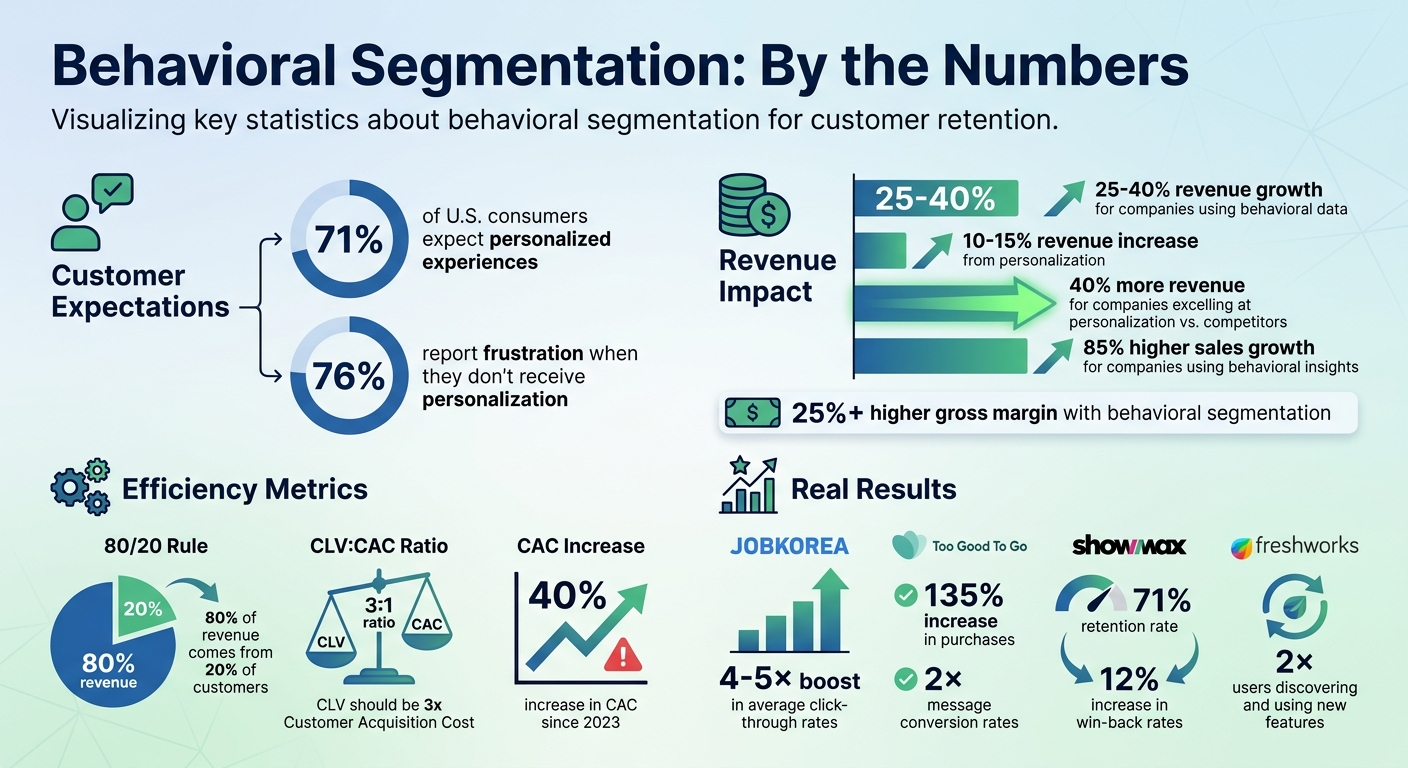
- Why it matters: Customers expect tailored experiences, with 71% of U.S. consumers valuing AI personalization. Companies using behavioral data see up to 25–40% revenue growth.
- Types: Includes purchase behavior (e.g., frequency, recency), usage patterns (e.g., session length), and timing (e.g., seasonal or milestone-based).
- Benefits: Drives higher retention, boosts revenue by aligning offers with intent, and ensures efficient resource allocation.
- How to start: Focus on clear KPIs like churn rate and lifetime value, test small segments, and automate responses to key triggers.
Behavioral segmentation ensures businesses act on real-time customer data, enabling smarter retention strategies and better outcomes.
Behavioral Segmentation Impact: Key Statistics and ROI Metrics
Master Customer Segmentation: Boost Engagement & ROI with AI.
sbb-itb-c00c5b1
Types of Behavioral Segmentation for Retention
Understanding behavioral segmentation helps pinpoint the customer actions that impact retention the most. Each type sheds light on different customer interactions with your brand, offering insights to predict and reduce churn. By identifying these behaviors, you can create targeted strategies to address key moments in the customer journey.
Purchase Behavior
Purchase behavior focuses on what, when, and how customers buy. This includes metrics like purchase frequency, recency, average order value (AOV), and discount usage. For example, RFM Analysis groups customers into categories such as "Active", "At Risk", or "Lapsed" [8]. A customer with two purchases in the last 30 days might respond well to loyalty rewards or early product access, while someone who hasn’t purchased in 120 days may need a win-back campaign.
Price sensitivity is another factor. While discounts can attract price-conscious buyers, they might erode margins if overused. On the other hand, perks like free shipping or faster delivery can encourage loyalty. Changes in purchase behavior – such as a shift from buying full-price items to only discounted ones, or a drop in order frequency – can serve as early warning signs of churn [3][7].
Usage and Engagement Patterns
Usage patterns reveal how customers interact with your product or service, tracking factors like session length, login frequency, and feature adoption. Customers often fall into one of four categories: heavy users (daily engagement with advanced features), moderate users (regular but basic use), light users (occasional logins with limited feature use), and inactive users (no activity for 30+ days) [2][5].
"Braze has allowed me to try different things as a CRM manager… being able to configure personalized messages with Liquid, A/B test with color and creative variations, diversify campaigns, and review performance reports without having to ask the development team has made my job more efficient."
JOBKOREA, a recruitment platform, leveraged user behavior and custom attributes to create dynamic segments. By personalizing messages and using A/B testing to refine engagement strategies, they achieved a 4–5× boost in average click-through rates [1].
Usage frequency can also predict churn. For instance, a sudden drop in session lengths or a lack of logins during the first week of a subscription often signals a higher risk of cancellation [3][5]. Recognizing these patterns allows businesses to intervene with timely offers or support.
Occasion and Timing
Occasion-based segmentation focuses on engaging customers at the right time. This could involve seasonal events (like holidays or back-to-school), life milestones (such as weddings or moving), or subscription renewal cycles [4][5][7].
Too Good To Go, a platform aiming to reduce food waste, used occasion and timing data to notify users when surplus food "Surprise Bags" were available nearby. By aligning messages with app sessions and purchase history, they saw a 135% increase in purchases and doubled their message conversion rates [1].
Timing outreach around subscription renewals can also help prevent passive churn. Seasonal triggers, like promoting winter gear in November or tax software in March, ensure your campaigns resonate with customer needs at the right moment.
Benefits of Behavioral Segmentation for Retention
When you break down customer actions into distinct behavioral segments, the advantages quickly become clear. Behavioral segmentation transforms customer data into actionable strategies, leading to better retention, increased revenue, and smarter use of resources. Whether you’re analyzing purchase habits or engagement timing, each type of segmentation plays a role in improving performance.
Higher Retention Rates
Behavioral data helps you spot early warning signs of churn, allowing timely and targeted actions like automated support or re-engagement campaigns. For example, if a user’s login frequency drops or they skip content, you can step in before they disengage completely. Sending personalized reminders to users who abandon onboarding or re-engagement offers to those inactive for over 30 days can make a significant difference. 71% of U.S. consumers expect personalized experiences, and 76% report frustration when they don’t get them [1]. This makes relevance and timing more important than ever.
Improved Revenue and Engagement
Personalization based on behavioral segmentation can increase revenue by 10%–15% [1]. Companies that excel at this approach see 40% more revenue from personalization efforts compared to slower competitors [1]. The key lies in aligning offers with real buyer intent – whether that’s price sensitivity, convenience, or specific feature preferences – rather than relying solely on demographic data.
Behavioral segmentation doesn’t just boost revenue; it also ensures resources are allocated more effectively.
Resource Efficiency
Gone are the days of generic, one-size-fits-all campaigns. Behavioral segmentation allows businesses to focus their efforts where they matter most. Companies using these insights outperform their peers by 85% in sales growth and over 25% in gross margin [11]. Instead of wasting resources on low-intent customers, you can channel your budget into high-value segments.
Take the 80/20 rule as an example: 80% of revenue typically comes from 20% of customers [10]. Behavioral data helps identify those high-value groups so you can prioritize them. A great example is Freshworks, which discovered through behavioral analytics that users weren’t adopting their new "Table View" feature because it was hard to find. By tweaking the UI based on this insight, they doubled the number of users discovering and using the feature [9]. This is a perfect case of solving the right problem for the right audience, saving time and resources while delivering better results.
How to Implement Behavioral Segmentation for Retention
Start small and grow your strategy over time. Many small businesses dive into complex segmentation models too quickly, wasting time and resources on metrics that don’t deliver results. Instead, focus on clear goals, manageable customer groups, and smart automation. These steps can help turn behavioral segmentation into actionable improvements for retention and efficiency.
Define Key Performance Indicators (KPIs)
Before segmenting customers, zero in on the metrics that matter most. Focus on five critical indicators: Retention Rate, Churn Rate, Repeat Purchase Rate, Customer Lifetime Value (CLV), and Referral Rate [12][10]. These metrics provide a clearer picture of customer health compared to vanity metrics like sign-ups or page views.
Here’s a key benchmark: your CLV should ideally be three times your Customer Acquisition Cost (CAC) – a 3:1 ratio that separates financially sustainable businesses from those burning cash [12]. With CAC rising by nearly 40% since 2023 [12], retention has become the most cost-effective way to drive growth.
Dig deeper into churn by analyzing customer tenure. For example, users who leave within the first 90 days may highlight onboarding challenges, while those who churn after a year could signal issues with product-market fit [12]. Another tool to consider is Customer Health Scoring, which combines factors like login frequency, feature usage, support interactions, and payment history into a single predictive score [12]. To keep your insights relevant, use score decay to ensure the data reflects current behavior rather than outdated trends [12].
Once you’ve defined your KPIs, you can move on to testing small, focused customer segments.
Start Small with 1-2 Segments
Begin with 5–10 key behavioral signals such as visits to your pricing page, demo completions, or specific feature usage [6]. Companies that start with a simple approach and refine it over time tend to perform better than those that overcomplicate things from the beginning.
For instance, in 2025, JOBKOREA, a South Korean recruitment platform, used dynamic segmentation and targeted automation to focus on a few key behavioral triggers. The result? A 4–5× boost in average click-through rates (CTR) [1]. This example shows that depth and precision often outperform complexity when starting out.
Test your segments with real campaigns before expanding. For SaaS businesses, try separating users who completed onboarding from those who didn’t. For e-commerce, divide first-time buyers from repeat customers. Run targeted campaigns for each group, measure the outcomes, and tweak your approach before adding more layers.
These small-scale tests create the groundwork for scalable, automated segmentation.
Use Automation Tools
Manual segmentation isn’t practical for scaling or reacting in real time. Automation tools can track user actions and trigger timely responses – like sending an abandoned cart email – when customer intent is at its peak [5][1].
For example, My Rich Brand’s marketing automation platform combines AI-driven analytics with human expertise to help businesses spot behavioral patterns and design personalized retention strategies. It integrates first-party data from websites and apps directly into your CRM, giving your team a unified view of the customer journey [5][13].
Another success story comes from Too Good To Go, a food waste reduction app. In 2025, they used automated behavioral triggers to notify users when nearby "Surprise Bags" became available. This approach led to a 135% jump in purchases linked to CRM efforts and doubled their message conversion rates [1]. By automating timing and personalization, the team could focus on strategy rather than manual tasks.
Start by automating high-intent triggers, such as multiple visits to a pricing page, cart abandonment, or inactivity for 25 days. Set up workflows to respond within an hour, and use A/B testing to refine your messaging and timing [5][14][1]. Over time, you can layer in predictive analytics to identify users likely to churn based on declining engagement or feature neglect [5][1].
Practical Applications of Behavioral Segmentation in Retention Strategies
Businesses are using customer behavior to craft timely, relevant experiences that not only boost engagement but also help reduce churn. Here’s how behavioral segmentation plays a role in retention strategies.
Personalized Onboarding
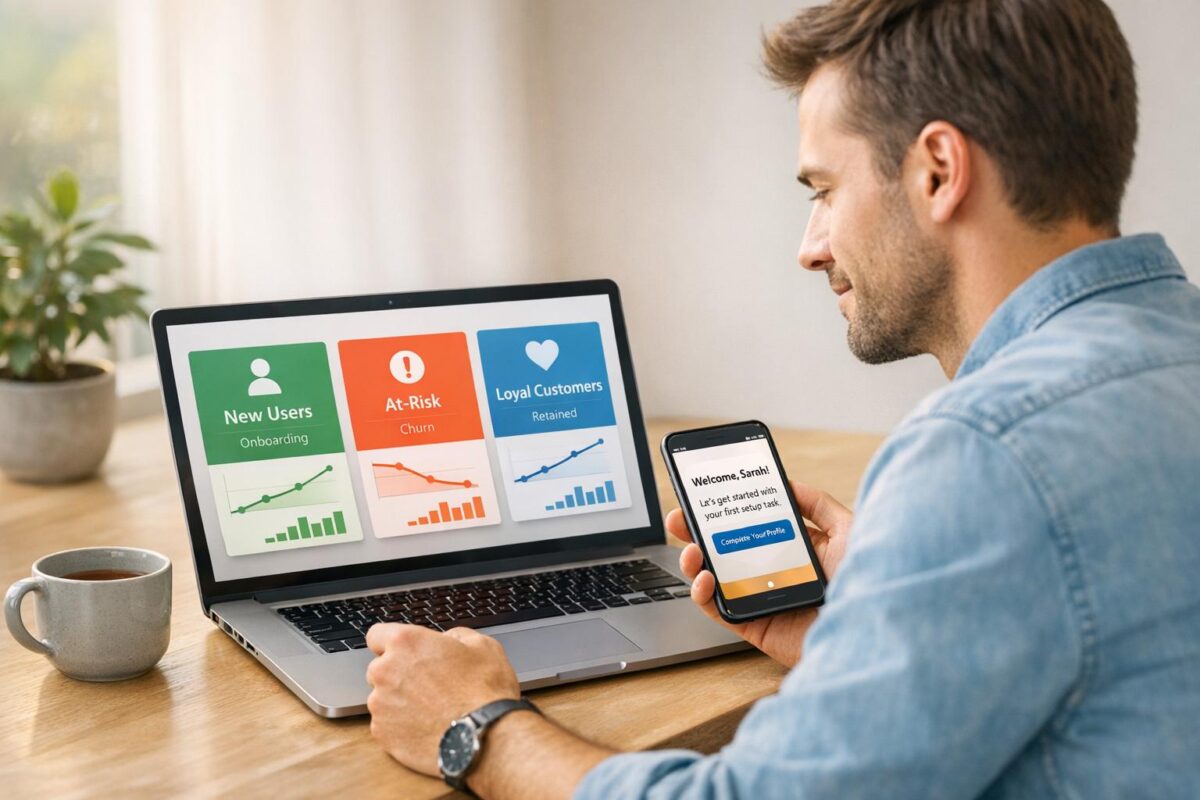
By tailoring onboarding experiences to user behavior, companies can improve early retention rates. For instance, segmenting users based on their journey stage allows for more relevant communication. First-time visitors might receive educational content, while returning trial users could get advanced feature highlights. Identifying high-value actions – like completing a product demo or integrating essential tools within the first week – can help guide users toward long-term engagement.
To make onboarding even more effective, create branching paths based on user activity. For example:
- Users who haven’t explored core features by day three might receive tutorials or walkthroughs.
- Power users could be sent advanced tips or even upgrade prompts.
And don’t forget about re-engaging users who drop off during onboarding. If someone stops interacting 48 hours after signing up, a well-timed message offering assistance or highlighting key features can bring them back.
After setting users up for success, the next step is preventing churn before it happens.
Churn Prevention
Behavioral segmentation is essential for spotting early signs of disengagement. Pay attention to "drifting" behaviors, like reduced logins, shorter sessions, or a drop in purchase frequency. Group customers into categories – heavy, regular, light, and inactive users – to identify those most at risk of leaving.
Automated re-engagement triggers can help bring dormant users back. For instance, if someone hasn’t logged in for 14 days, send a personalized "we miss you" message. This could include reminders of what they’re missing or even an incentive to return. The definition of "dormancy" should align with your business model – daily-use apps might act after just a few days, while seasonal products might wait longer.
A great example of this in action is Showmax, which in 2025 used behavioral segmentation to send personalized, cross-channel messages tailored to user lifecycle stages and preferences. The result? A 71% retention rate and a 12% increase in win-back rates [1].
For new subscription users, especially those who don’t log in within their first week, proactive support is key. Test different re-engagement strategies – like value-driven content versus direct offers – to see what works best for each segment.
Once churn risks are under control, focusing on customer milestones can further enhance engagement and encourage upgrades.
Milestone-Based Upgrades
Celebrating customer milestones is a natural way to encourage upgrades and upsells. Look for usage-based thresholds where heavy or power users are consistently engaging or maxing out their current plans. When users hit these points, trigger upgrade prompts that feel timely and relevant.
Real-time data can also help identify opportunities. For example:
- Send upgrade offers when users hit milestones like their 10th purchase or 50th app session.
- Target users who explore locked features or attempt to use premium tools, as these actions signal readiness for an upgrade.
Personal milestones, such as birthdays or anniversaries, are another great touchpoint. Recognizing these moments with tailored offers can strengthen loyalty. Research shows that customers who feel personalized attention are 1.8 times more likely to pay a premium and 3.7 times more likely to make additional purchases [5]. Use these occasions to deepen the relationship and encourage timely upgrades.
Conclusion
Behavioral segmentation offers a powerful way for businesses to understand and keep their customers. By focusing on actions rather than just demographics, you can uncover patterns that help predict future behavior. With 71% of U.S. consumers expecting personalized experiences, companies that tailor their efforts can see meaningful boosts in revenue [1].
The strategies discussed here – like personalized onboarding, churn prevention, and milestone-based upgrades – all depend on real-time behavioral data to deliver timely and relevant messages. Whether you’re addressing at-risk users or celebrating key customer achievements, behavioral segmentation ensures your resources are used where they matter most. That said, implementing these strategies can feel daunting, especially for smaller teams.
For small businesses, manually sorting through data can be a major hurdle. Automation tools, such as those from My Rich Brand, simplify the process by handling data analysis for you. These tools allow businesses to create dynamic, real-time segments, keeping retention campaigns aligned with shifting customer behavior.
Start small – focus on one or two segments, like purchase frequency or usage trends, and use first-party data to build accurate profiles. Once you’re comfortable, you can explore more advanced techniques like RFM analysis or predictive churn models. The key is to let customer actions guide your strategy, ensuring every move supports your retention goals.
FAQs
What behavioral data should I track first?
Tracking customer actions that showcase intent and engagement is a smart starting point. Pay attention to key behaviors like purchase history, browsing habits, email activity, and how customers respond to promotions. High-value actions – such as completing a purchase, abandoning a cart, or clicking on specific links – are especially important to monitor. These insights allow you to build customer segments based on real behavior, offering a more reliable way to predict future actions compared to relying solely on demographic information.
How do I spot churn risk from behavior signals?
Spotting churn risk involves identifying patterns of disengagement. This could include less frequent interactions, slower response times, or a noticeable decline in purchases. Pay attention to behaviors like repeated site visits without making a purchase or gradually decreasing engagement levels over time. By regularly analyzing these trends, you can catch early warning signs and take steps to address customer concerns, ultimately improving retention.
Which retention triggers should I automate first?
To keep users engaged and prevent churn, it’s smart to automate retention triggers that respond to their behavior. Focus on behavior-based email triggers – things like cart abandonment, product views, or sign-up actions. These types of emails are timely and relevant, making them more likely to grab attention and encourage action.
Another effective approach is behavioral segmentation. By analyzing actions like purchase patterns or key moments in the customer journey, you can create highly personalized experiences. This not only keeps users coming back but also builds loyalty over time.