


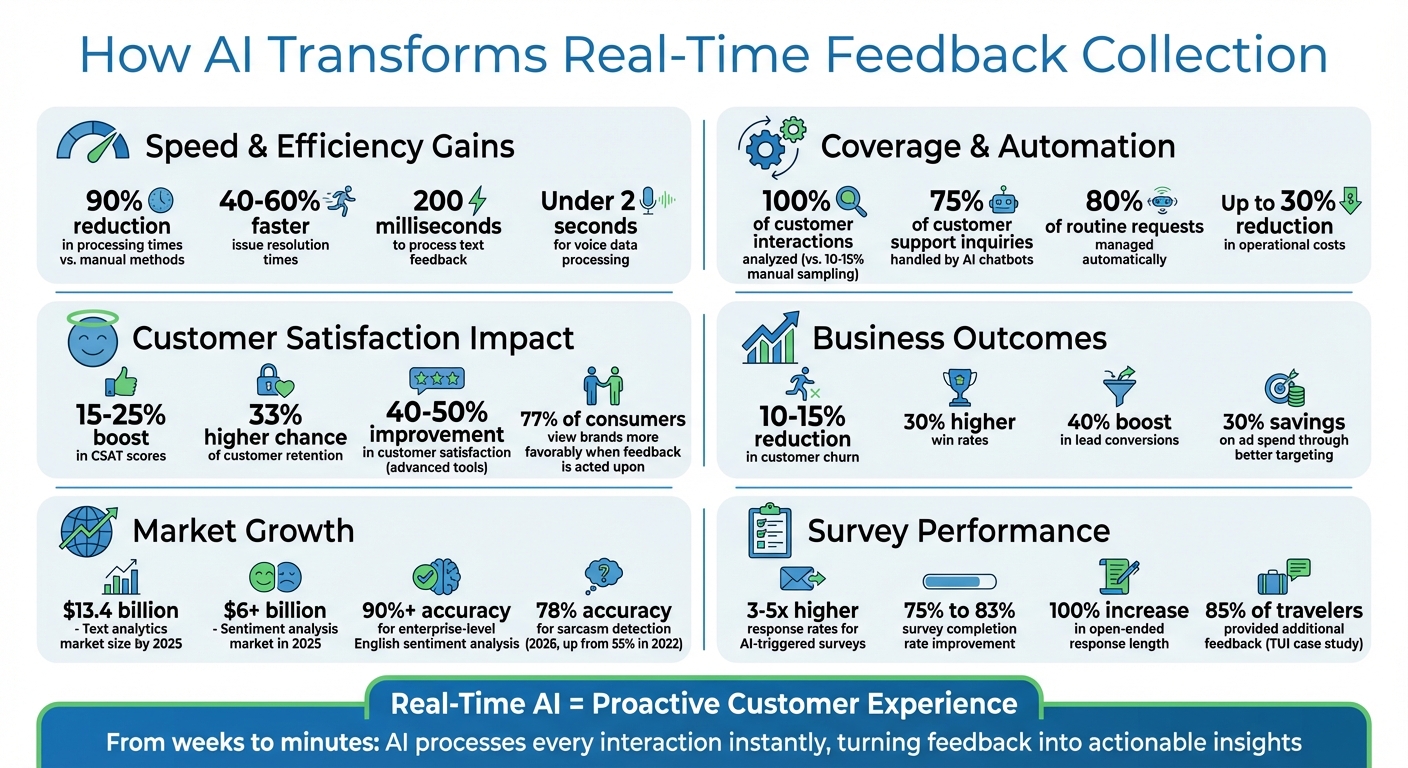
AI is transforming how businesses collect and act on customer feedback, cutting processing times by 90% compared to manual methods. Instead of waiting weeks for insights, companies now receive instant alerts, enabling faster decision-making and issue resolution. Key benefits include:
- Speed: AI processes feedback in real time, reducing issue resolution times by 40–60%.
- Coverage: Analyzes 100% of customer interactions across emails, social media, reviews, and more.
- Efficiency: Automates tasks like sentiment analysis and report generation, lowering operational costs by up to 30%.
- Customer Retention: Businesses using AI see a 33% higher chance of retaining customers and a 15–25% boost in satisfaction scores.
AI tools also integrate seamlessly with platforms like Salesforce, Zendesk, and marketing systems, turning feedback into actionable insights. From dynamic surveys to predictive analytics, AI enables businesses to address concerns proactively, improve customer experiences, and reduce churn by 10–15%.
AI-Powered Feedback Collection: Key Performance Metrics and Business Impact
Continuous Data Monitoring and Aggregation with AI
AI marketing strategies for multichannel feedback collection
AI platforms gather feedback from every corner of a business’s operations. They seamlessly connect with tools like Salesforce for CRM, Zendesk for customer support, Slack and Gong for communication, social media platforms, and even sales call tracking systems. By doing so, they create a unified view of diverse data sources, pulling information from public review sites like Google and TripAdvisor, internal surveys, and specialized systems like Toast for point-of-sale or Mews for property management [2][4].
This approach ensures customer interactions across various channels are captured. Even physical touchpoints, such as QR codes and NFC-enabled devices, are included in the mix [5]. The growing reliance on such technology is evident, with the text analytics market expected to hit $13.4 billion by 2025 [2].
"Real Time Feedback gives members the outlet they deserve and it also gives us the opportunity to address their issue in a timely manner." – Samantha Cacchione, Gold’s Gym SoCal [5]
Once collected, this feedback is synchronized across platforms instantly.
Real-Time Data Synchronization
AI processes incoming data streams as they arrive, analyzing sentiment and identifying key themes. This eliminates the wait times associated with manual data handling. Whether it’s a completed purchase, a closed support ticket, or a posted review, the AI immediately categorizes feedback into topics like pricing, user experience, or feature suggestions – no manual tagging required [2][4]. This level of immediacy enables teams to respond to insights the moment they appear.
Businesses using real-time feedback systems see a 33% higher chance of retaining customers [8]. The synchronization across all platforms ensures consistency, creating what experts call a "single source of truth." Rick Beadles, General Manager at Huffines Auto Group, highlights this benefit:
"The system is immediate, user-friendly, and very concise. This allows us to be proactive with any issues that may arise" [5].
sbb-itb-c00c5b1
Automated Surveys and Chatbot Deployment
AI-Powered Chatbots for Instant Feedback
AI-driven chatbots are revolutionizing how businesses gather feedback. These bots can collect responses through web popups, in-app widgets, WhatsApp, or even social media platforms [12][13]. They’re programmed to request feedback at key moments – like after completing a task, engaging with a feature, reaching a milestone, or finishing a support interaction [12][11].
What makes these chatbots stand out is their use of natural language processing (NLP), enabling them to hold smooth, conversational interactions [12][14]. Customers can share their thoughts in various formats, including text, voice recordings, screenshots, or even short videos [12]. If a customer’s feedback suggests dissatisfaction, the chatbot can immediately escalate the issue to a support team [12][11].
The results speak for themselves: surveys triggered by customer behavior or context see response rates that are 3–5 times higher than traditional email surveys [11]. And looking ahead, it’s predicted that by 2025, generative AI could autonomously manage up to 70% of customer interactions [8].
With this kind of real-time adaptability, chatbots are setting a new standard for collecting and acting on customer feedback.
Dynamic Survey Questions That Adapt to Responses
AI doesn’t stop at chatbots – it’s also transforming traditional surveys into smarter, more personalized tools.
Using conditional logic, AI turns static surveys into dynamic conversations that adjust based on the customer’s responses [12][14]. For example, a low rating might prompt a follow-up question like, “What went wrong?” while a high rating could lead to, “What did we do well?” This kind of branching ensures customers only answer relevant questions, skipping over anything that doesn’t apply to them [15][16].
AI even picks up on vague or unclear responses as they’re being typed, generating thoughtful follow-up questions to gather more detailed information [6]. Take the example of TUI’s July 2025 pilot program with Qualtrics AI: By using an “Adaptive Follow-Up” system, TUI encouraged 85% of its 30 million annual travelers to provide additional feedback. This approach boosted the total word count of responses by 75%, giving frontline teams the insights they needed to resolve issues before guests even checked out [6].
"The quality of insights you extract from customer feedback depends entirely on the quality of questions you ask." – FeedbackRobot [15]
To combat survey fatigue, AI creates short, focused micro-surveys with just 3–5 questions, prioritizing the most critical data points. It also leverages existing customer data to make questions more relevant and tailored [15][16].
This combination of adaptive questioning and concise design ensures businesses get meaningful feedback without overwhelming their customers.
How to Create an Automated Feedback System using AI Agent
Real-Time Sentiment Analysis with NLP
With advancements in real-time data collection and automated surveys, natural language processing (NLP) has taken sentiment analysis to a whole new level. NLP allows AI to go beyond simple keyword recognition and grasp the intent, tone, and emotions behind customer feedback. It can even handle complex industry-specific jargon, acronyms, and subtle nuances that distinguish a compliment from a complaint [4].
The process typically involves three main steps: cleaning the text, breaking it into tokens (tokenizing), and assigning sentiment scores based on polarity (positive or negative) and intensity [20]. Cutting-edge systems now integrate additional layers like voice tone, facial micro-expressions, and word choice into a unified sentiment analysis framework. This multi-modal approach has reduced misclassification rates by up to 30% compared to relying solely on text [19].
One standout technique, Aspect-Based Sentiment Analysis (ABSA), focuses on identifying sentiment tied to specific elements within feedback. For instance, it can distinguish between a customer praising pricing while criticizing site navigation [19]. Emotional AI goes even further, identifying nuanced feelings like frustration, confusion, or disappointment, helping businesses prioritize their responses more effectively [4]. Companies using these advanced tools report customer satisfaction improvements of 40–50% [4].
Speed is a game-changer in real-time sentiment analysis. Leading NLP tools can process text feedback in under 200 milliseconds and voice data in under two seconds. This enables businesses to respond instantly during live interactions [19]. The global sentiment analysis market exceeded $6 billion in 2025, with enterprise-level accuracy surpassing 90% for English-language data [19]. Even sarcasm detection has seen major progress, with accuracy jumping from 55% in 2022 to 78% in 2026, thanks to large language models [19]. These advancements make it possible to scale sentiment analysis across massive datasets without compromising speed or accuracy.
Understanding Customer Sentiments at Scale
Manually reviewing thousands of customer comments? That’s just not feasible. AI-powered sentiment analysis solves this by processing every single piece of feedback in real time. This eliminates the need for sampling or outdated batch reports [17]. Businesses leveraging this technology often achieve a 40–60% reduction in time-to-resolution for customer issues and see satisfaction scores rise by 15–25% [3].
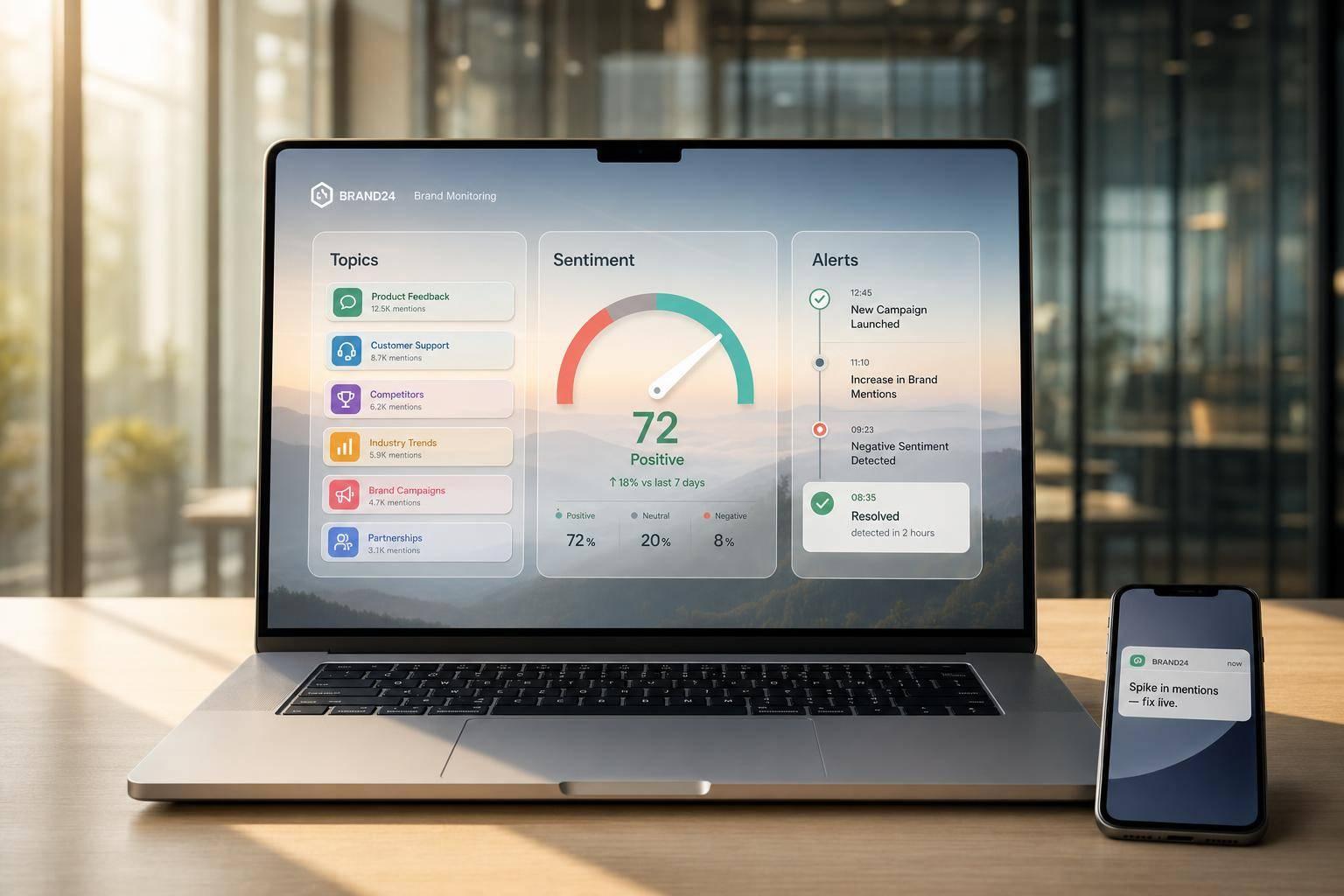
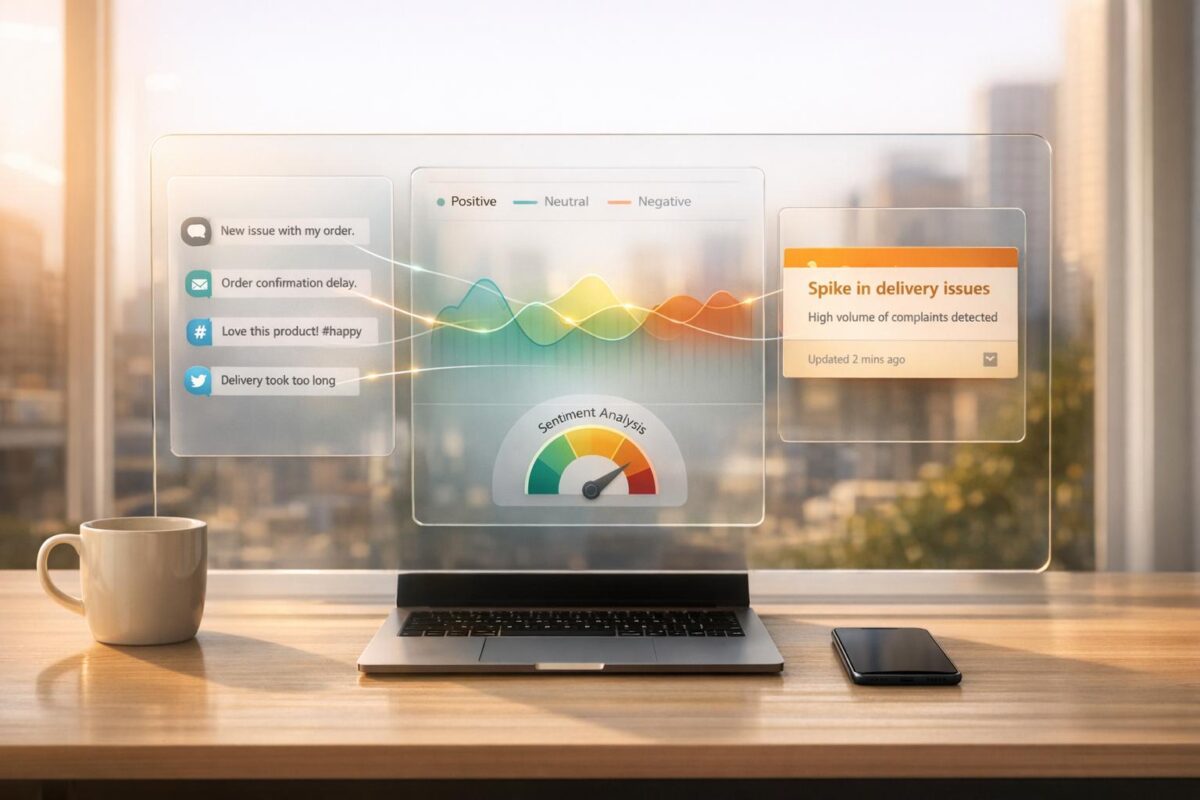
One of the biggest benefits of real-time sentiment analysis is its ability to generate immediate, actionable alerts. For example, when negative sentiment spikes, businesses can intervene right away [19]. Real-time coaching based on sentiment insights can boost first-call resolution rates by 25–35% [19]. Additionally, automated tools like "Resolution Engines" can respond instantly to frustration or anger by sending empathetic messages or offering discounts [20].
To maintain high accuracy, combining AI with human oversight is essential. While AI handles large-scale processing, humans can step in to interpret sarcasm, irony, and other nuanced expressions [17][21]. Fine-tuning sentiment models for company-specific terminology and product names can improve accuracy by 5–10 percentage points [19]. Regularly comparing AI outputs with human annotations ensures the system stays sharp and avoids performance dips over time [20].
AI-Generated Insights and Actionable Alerts
Gathering feedback is just the first step; the real value lies in transforming that data into quick, actionable decisions. AI takes customer comments, identifies patterns, flags urgent concerns, and notifies teams almost instantly. This shift from reacting to problems to proactively addressing them is what separates businesses struggling with customer retention from those consistently improving satisfaction scores.
AI now monitors every customer conversation across all channels and generates alerts in just minutes. Companies using real-time AI feedback analysis often see a 15–25% boost in CSAT scores [3]. By integrating feedback from platforms like CRM systems, helpdesks, social media, and chat tools into one unified feed, AI uncovers connections that might otherwise go unnoticed. For instance, it can link a survey complaint about a "confusing checkout" with multiple support tickets mentioning "payment failure", revealing a single underlying issue [17]. Beyond real-time alerts, AI also predicts potential problems before they escalate.
Predictive Analytics for Proactive Solutions
AI doesn’t just analyze what’s already happened – it forecasts what’s likely to happen next. By examining historical data and emerging sentiment trends, predictive models can identify at-risk customers before they voice dissatisfaction or decide to leave [4][8]. This represents a shift from merely addressing problems to preventing them altogether.
Predictive analytics works by analyzing multiple data points at once. AI evaluates behavioral patterns, sentiment levels, support ticket frequency, and engagement metrics to predict Net Promoter Scores and spot potential detractors even before they complete a survey [8]. Companies adopting this approach can reduce churn by 10–15% and improve win rates by up to 30% [8]. Additionally, AI can predict operational challenges, such as peak traffic periods or staffing shortages, allowing businesses to address these issues before they disrupt customer experiences [24].
Advanced systems take this a step further with closed-loop learning, where AI continuously improves its predictions by analyzing the outcomes of its past recommendations [18]. This means the longer the system is in use, the better it becomes at understanding and anticipating customer needs. Beyond forecasting problems, AI also generates detailed trend reports to guide ongoing improvements.
Automated Feedback Trend Reports
Manually creating reports is often slow and incomplete. AI solves this by automatically producing concise trend reports that highlight key customer concerns. Instead of analyzing just a small sample of feedback, AI processes every single interaction to surface the most critical themes [3][17].
These reports go beyond simple sentiment analysis. AI uses thematic analysis to group recurring issues – like "slow service" or "checkout errors" – even when customers describe the same problem in different ways [2][22]. For example, in 2025, the cybersecurity firm Cynet used Mosaic AI to streamline its customer feedback process. By centralizing knowledge and using AI to address common questions, Cynet boosted its CSAT score from 79 to 93 and achieved a 47% ticket deflection rate [4].
AI-generated reports also enable role-specific dashboards, giving product, sales, and support teams direct access to real-time customer insights [4][18]. This ensures that decisions aren’t delayed by relying on a single analytics team. For instance, the luxury brand Liberty used Zendesk QA to analyze 100% of its customer support interactions. By identifying areas for improvement and providing targeted training for agents, the company maintained a steady 88% CSAT score [23].
The demand for these tools is growing rapidly, with the text analytics market expected to reach $13.4 billion by 2025 [2]. Additionally, 77% of consumers say they view brands more favorably when those brands actively seek and apply feedback [22]. AI not only helps collect this feedback but also makes it possible to act on it immediately.
Integrating AI Feedback Tools with Digital Marketing Platforms
Taking automated alerts and proactive insights a step further, integrating AI feedback tools with marketing platforms ensures every customer interaction has a purpose. Gathering feedback is one thing – but if it sits disconnected from systems like your CRM, email automation tools, ad platforms, or content management systems, it’s a missed opportunity. The real magic happens when these insights flow directly into your marketing operations. This connection lets businesses act immediately – adjusting ad targeting, refining SEO strategies, and tailoring email campaigns based on real-time customer input [25][9].
Modern AI platforms excel at consolidating customer data into unified profiles. For example, if a customer mentions "confusing navigation" during a support chat, that feedback can trigger updates to the website design and even send a follow-up email addressing the concern. Similarly, when sentiment analysis highlights excitement over a specific product feature, marketing teams can pivot ad campaigns to emphasize that benefit almost instantly [9][22].
"AI tools are a game changer in developing personalized marketing strategies, significantly improving efficiency and effectiveness in managing brand strategy." – My Rich Brand [25]
Businesses leveraging AI-driven marketing automation report impressive results, such as a 40% boost in lead conversions by acting on feedback in real time [25]. AI chatbots, for instance, manage up to 75% of customer support inquiries while simultaneously funneling qualified leads into automated email campaigns [25]. Additionally, companies save up to 30% on ad spend by using feedback patterns to target high-intent audiences more accurately [25]. Tools like My Rich Brand demonstrate how marketing automation platforms can scale these insights for targeted campaigns.
Scaling Insights with Marketing Automation
Platforms like My Rich Brand make it possible to turn customer feedback into actionable marketing strategies at scale. Using their AIME™ (AI Automated Marketing Ecosystem) framework, businesses can automate up to 80% of their marketing tasks. This includes everything from generating AI content marketing assets based on customer language to dynamically adjusting ad spend. Meanwhile, human marketers can focus on fine-tuning these campaigns for optimal results [25].
Take SEO as an example. AI tools can extract keywords and topic clusters directly from feedback data, offering content recommendations rooted in customer preferences [25][9]. If users consistently praise a "fast checkout" experience, that phrase can become a priority keyword in blog posts, ad copy, or even product descriptions. Real-time sentiment monitoring across platforms like social media and support channels allows marketers to shift campaign messaging as customer opinions evolve [9][22].
My Rich Brand offers flexible pricing tiers to suit different business needs. The Starter Plan, priced at $599/month, includes AI chatbot setup and two SEO-optimized articles. For more advanced needs, the Elite Plan at $1,499/month provides full AIME™ implementation, eight monthly articles, and end-to-end sales funnel management [25].
This integration also streamlines lead nurturing. For instance, when a customer completes a survey expressing interest in a particular service, AI can automatically enroll them in a targeted email sequence, schedule a follow-up, and notify the sales team – all without requiring manual input [25][10]. This kind of synchronization ensures that 77% of consumers who favor brands that act on feedback see those changes reflected in their interactions [22].
Measuring Success with Key Metrics
Once AI feedback tools are in place, it’s essential to show measurable improvements. This isn’t just about gathering feedback – it’s about proving that AI speeds up team responses, improves customer satisfaction, and simplifies operations.
Tracking Customer Engagement Metrics
Start with the basics: Customer Satisfaction Score (CSAT), Net Promoter Score (NPS), and Customer Effort Score (CES). These metrics provide a clear view of how AI is shaping the customer experience. For example, companies using AI for feedback often see a 15-25% boost in CSAT scores and a 30% drop in support escalations [3]. But don’t stop at just scores – dig deeper. AI-powered conversational feedback tools can push survey completion rates from 75% to 83% [6], and dynamic follow-up questions can result in a 100% increase in the length of open-ended responses [6].
Operational efficiency metrics are just as crucial. Keep an eye on time-to-resolution for customer issues. Real-time AI analysis can slash resolution times by 40-60% [3]. Track how many inquiries AI handles automatically – advanced systems can manage over 80% of routine requests [1]. Also, measure the volume of actionable insights and the tone of customer sentiment (positive, negative, or neutral) across all channels [7][6]. For a forward-looking approach, monitor support escalation rates and use predictive analytics to spot early signs of customer churn [17][3]. These operational gains highlight the advantages of shifting from manual to AI-driven feedback systems.
To confirm these benefits, compare pre- and post-AI metrics regularly.
Comparing Pre- and Post-AI Metrics
Side-by-side comparisons make AI’s impact crystal clear. Traditional manual analysis typically reviews only 10-15% of feedback and takes 3-6 weeks to deliver insights [3]. In contrast, AI analyzes 100% of conversations in real time [3]. This shift from reactive fixes to proactive management demonstrates a clear return on investment.
Start by documenting baseline KPIs – like NPS, CSAT, response times, and survey review rates – before implementing AI [17][3]. After implementation, track these metrics monthly. For instance, a software company with 25,000 users used real-time AI to spot a 300% spike in negative comments about navigation right after a major update. By identifying the issue within hours, developers resolved the bug in just 24 hours. The CTO estimated this quick action avoided a potential 5% increase in churn, which would have occurred with the usual 2-3 week delay from manual reporting [3]. Use live dashboards to monitor sentiment trends and compare results by region, product line, or customer type to pinpoint exactly where AI delivers the most impact [22].
Conclusion
AI has completely reshaped how businesses handle real-time customer feedback. By combining data collection, automated surveys, and predictive sentiment analysis, companies can now respond to customers almost instantly. AI seamlessly pulls insights from social media, support tickets, reviews, and chat transcripts, turning scattered data into a unified view. It doesn’t stop there – advanced natural language processing (NLP) helps interpret sentiment, clarify vague responses, and even predict potential customer churn.
The results speak for themselves: businesses have reported 10–15% lower churn, 30% higher win rates, and 30% lower operational costs [8]. For example, TUI saw a 75% increase in detailed customer feedback using their AI-powered system, allowing teams to address issues before customers even checked out [6].
"This is more than just a Voice of the Customer program. This is about human connection at scale. It’s about making sure that every guest, on every journey, feels heard – and valued."
– Kira Drabner, Head of Voice of Customer Program, TUI [6]
It’s clear that listening to customers pays off. In fact, 77% of consumers view brands more favorably when they actively seek and act on feedback [22]. AI takes this one step further by connecting every interaction to actionable growth strategies, from generating predictive alerts to creating scalable, automated responses.
Ready to transform how you handle feedback? My Rich Brand specializes in AI personalization in marketing and digital solutions to elevate your customer experience. With a blend of AI technology and human expertise, they help businesses turn customer insights into real-time growth opportunities.
FAQs
What data sources should I connect first for real-time feedback?
To get started, link up data sources that collect feedback from different channels. Platforms such as Zefi, Medallia, Mesh.AI, Revuze, and My AI Front Desk can process input from multiple touchpoints in real time. These tools provide insights you can use to refine and enhance customer experiences.
How accurate is AI sentiment analysis for slang and sarcasm?
AI sentiment analysis faces challenges when it comes to interpreting slang and sarcasm. These forms of communication are packed with nuance and irony, making them tough for machines to decode. While advanced tools like transformer models have made strides in understanding context, accurately identifying these subtleties continues to be a hurdle for deep learning systems.
How do I measure ROI after switching to AI-driven feedback?
To gauge ROI effectively, zero in on a few critical metrics. Start with cost savings achieved through automation, which can reduce manual labor and operational expenses. Look at revenue growth driven by actionable insights and productivity gains stemming from quicker analysis processes. Additionally, keep an eye on customer experience improvements, such as shorter response times and higher satisfaction scores, as well as the speed of decision-making. By tracking these metrics consistently, you can assess how AI enhances your feedback process and ensures alignment with your business objectives.