


If I had to sum it up in one line: AI brand monitoring helps teams spot problems in hours instead of days or weeks, then act before brand damage spreads.
I see the article making one clear point: the win is not more data. The win is a simple flow:
- spot the signal
- find the pattern
- act fast
- measure the result
Here’s the article in plain English:
- Coca-Cola used live monitoring to shift campaign decisions while ads were still running, instead of waiting six weeks for feedback.
- Starbucks used customer feedback from app reviews, social posts, and store comments to find repeat issues like long wait times and order customization friction.
- A skincare brand caught a packaging defect by 11:30 AM on launch day and avoided about $50,000 in returns.
- Other examples show the same pattern: early warning can stop rating drops, fix listing errors, and cut issue response time.
A few numbers stand out:
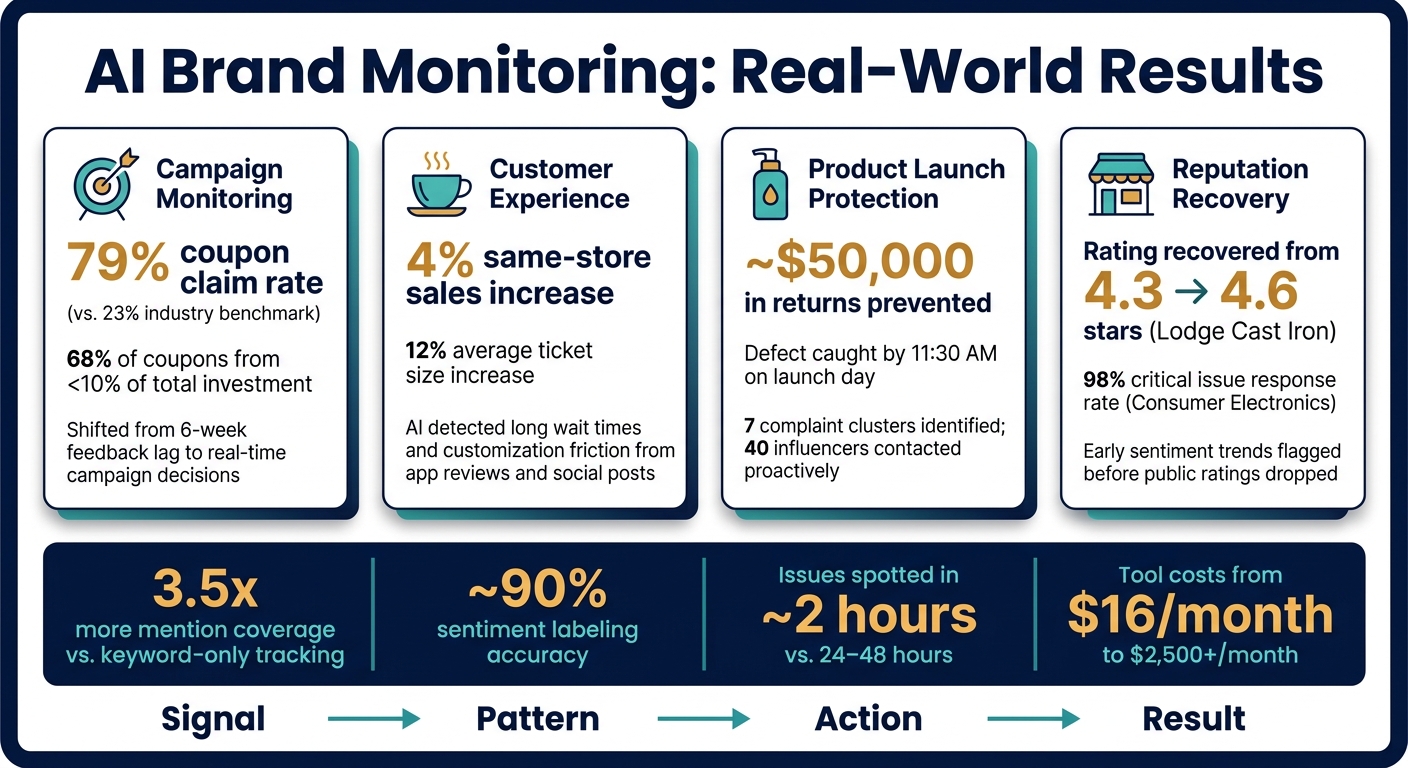
- AI tools can deliver 3.5x more mention coverage than keyword-only tracking
- Sentiment labeling can reach about 90% accuracy
- Some issues can be spotted in about 2 hours instead of 24 to 48 hours
- Tool costs can range from about $16/month to $2,500+/month
If I were taking the main lesson from these case studies, it would be this: watch the channels that matter, set clear alert rules, and make sure someone owns the response.
Quick comparison
| Brand / Sector | What AI tracked | What team did | Result |
|---|---|---|---|
| Coca-Cola | Campaign sentiment, timing, audience response | Changed messaging and ad timing during live campaigns | Faster campaign feedback; 79% coupon claim rate in one use case |
| Starbucks | App reviews, social posts, customer feedback | Changed staffing and app order options | 4% same-store sales increase; 12% average ticket size increase in stores using the platform |
| DTC beauty brand | Complaint clusters tied to packaging | Contacted affected customers and influencers early | About $50,000 in avoided returns |
| Retail / hospitality examples | Reviews, ratings, topic clusters | Fixed listing issues and addressed service problems early | Rating recovery and fewer public complaints |
So if you want the short answer, here it is: these case studies show that AI brand monitoring works best when alerts lead straight to action. The rest of the article explains how that plays out across marketing, customer service, and day-to-day business decisions.
AI Brand Monitoring Case Studies: Real Results at a Glance
How AI Brand Monitoring Works in Practice
Data Sources, Coverage, and Real-Time Alerts
AI brand monitoring pulls data from social platforms, review sites, news outlets, forums, and visual media like short-form video. In practice, that means teams can track brand mentions across both text and images or video, instead of leaning on keyword matching alone.
That matters because people don’t always use the exact words you expect. They post screenshots, film quick product clips, or mention a brand in passing without tagging it. AI tools that group related mentions can deliver 3.5x more mention coverage than older keyword-only systems [3]. And when something goes wrong, speed matters just as much as reach. AI can spot a product defect or a sharp change in sentiment in about 2 hours, compared with 24–48 hours through standard customer service channels [4].
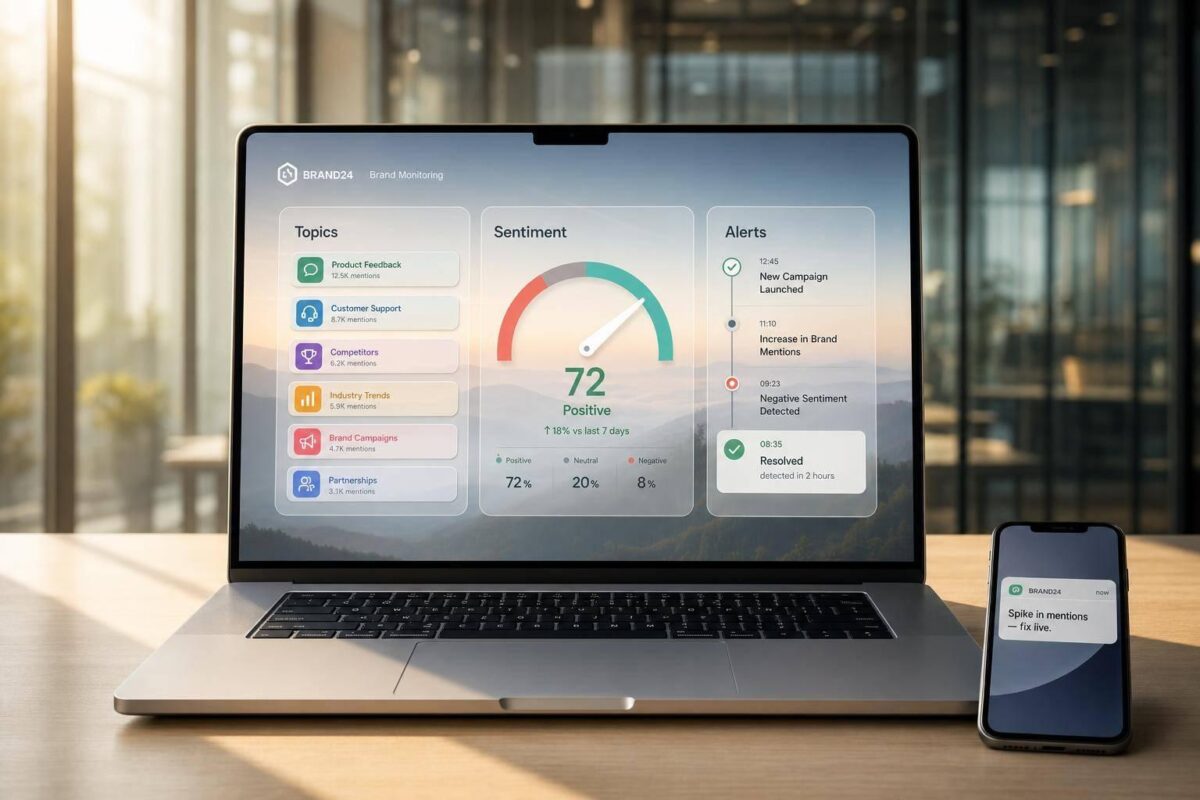
Once the system picks up that signal, it sorts it by sentiment, themes, and alert level so teams can act without digging through a mess of raw mentions.
Sentiment Analysis, Topic Detection, and Predictive Brand Health
Mention volume on its own doesn’t tell you much. A spike could mean people love the product, hate it, or are just confused. That’s why AI labels mentions as positive, negative, or neutral – now at about 90% accuracy [2] – and groups them into topics like shipping delays, packaging issues, or product defects.
That kind of sorting helps teams catch trouble before it snowballs.
In February 2026, DTC skincare brand Luma Botanics used Grok to watch a vitamin C serum launch. By 11:30 AM on launch day, the AI had grouped seven matching complaints about a dropper that was 0.3 in too short, which pointed to a packaging defect. The team then reached out to the 40 influencers and customers who had received the product before bad reviews had time to spread. That move prevented an estimated $50,000 in returns [4].
Predictive brand health scoring pushes this a step further. It tracks sentiment over time, so teams can tell whether a negative spike is cooling off or picking up steam. That gives them a clearer read on when to restart normal promo activity after a rough launch or a wave of public complaints.
How Teams Put Insights to Use
These insights don’t just sit in a dashboard. They move to different teams based on urgency. A tiered alert setup helps companies get the right signal to the right people without flooding everyone with noise.
- Red alerts – triggered by crisis keywords plus influencer engagement – go straight to communications and leadership through Slack [1].
- Yellow alerts – which point to unusual sentiment velocity – go to marketing and customer care for close watch [1].
- Standard mentions roll into weekly reports.
Marketing teams use dashboards to shift messaging and media spend in near real time. Operations teams jump on product-specific clusters, like complaints about a broken seal or a delayed shipment, before those issues clog support queues. These workflows set up the Coca-Cola and Starbucks cases that follow.
sbb-itb-c00c5b1
Case Study: Coca-Cola and AI-Led Campaign Monitoring
Tracking Campaign Sentiment Across High-Volume Social Channels
Coca-Cola’s products get mentioned online about every two seconds [9], and its campaigns run across more than 50 countries [6]. That kind of volume made Coca-Cola a strong case for live brand monitoring.
Before AI, the company had to wait six weeks for campaign feedback: four weeks of field research and two more weeks of agency analysis [6]. By the time the findings came back, the campaign was often already finished.
"What we needed was to take weeks and cut it down to either days or hours." – Greg Pharo, Global Senior Director of Communications and Marketing Effectiveness, The Coca-Cola Company [6]
To fix that lag, Coca-Cola launched the "Excite" program under Greg Pharo’s leadership. Instead of static PowerPoint decks, the team moved to interactive dashboards that marketers could check while campaigns were still running. Those dashboards showed which creative assets were landing with specific audience segments [6].
Coca-Cola also uses YouScan for social listening across regional markets. In Central Asia and the Caucasus, the team tracked six countries in Georgian, Russian, and Kazakh, while Telegram alerts flagged sentiment shifts and new topics as they appeared [7]. Those signals didn’t just sit in reports. They shaped active campaign decisions in the moment.
Using AI Insights to Adjust Messaging and Media Mix
In Saudi Arabia in April 2025, Coca-Cola used its "Hey AI!" model to spot which foods people paired with Coke outside standard meal times, then served ads at those times. The result was a 79% coupon claim rate, compared with a 23% industry benchmark [8]. Even more striking, that segment produced 68% of claimed coupons while using less than 10% of total investment [8].
The bigger change wasn’t just speed. It was access. Live data no longer stayed locked inside analyst reports. Marketing, communications, and operations teams could all look at the same view of brand performance at the same time [6].
Signal, insight, action, outcome – that cycle now moves in hours instead of weeks.
The same speed matters when customer feedback starts in service channels, not social media.
AI Media Monitoring for Marketing Managers
Case Study: Starbucks and Real-Time Feedback for Customer Experience
Starbucks shows how the same listening model can spot customer-experience issues after purchase, not just reactions to a campaign. The company handles millions of customer interactions each week, which gives its AI a steady flow of feedback to review. That system sorts app reviews, social posts, and in-store feedback by issue, so repeat problems show up fast.
Finding Repeat Customer Issues in Social Posts and App Reviews
Starbucks uses a voice-of-customer system that sends feedback into one central data platform. From there, AI and Natural Language Processing (NLP) tools tag conversations by topic and sentiment [10]. A complaint about a drink may get tagged as "Drink Quality". A post about slow service may fall under "Wait Times." Over time, those labels make it easier to spot patterns instead of treating each complaint as a one-off.
Two issues came up again and again: long wait times and customization friction. AI found that highly customized orders were slowing prep times and adding pressure on staff during busy hours [12].
From AI Signals to Operational Changes and Better Brand Perception
The pattern was hard to miss: repeated service friction, not isolated complaints, drove the biggest changes.
Once Starbucks confirmed those patterns, it moved from insight to action. Its Deep Brew AI engine started predicting rush hours and adjusting staffing levels to cut wait times [13]. Its companion Siren AI system added local factors like holidays, community events, and weather to fine-tune those schedules even more [13]. In early 2024, an AI-piloted spring campaign using AI personalization in marketing led to a 4% increase in same-store sales, and stores using the platform saw an average 12% increase in ticket size [11].
The app changed too. After steady feedback asking for more detailed order controls, Starbucks added specific cup sizes and ice modification options inside the mobile interface. That update came straight from voice-of-customer data analysis [10].
| Key Issue Detected | AI Signal | Business Change Implemented |
|---|---|---|
| Long wait times | Negative sentiment spikes tagged "Wait Times" in specific regions [10] | AI-driven staffing optimization via Siren to predict and staff for rush hours [13] |
| Customization friction | High volume of app reviews requesting specific ice and cup adjustments [10] | Added specific cup sizes and ice modifications to the mobile app interface [10] |
"This way, AI allows employees to spend more time connecting with customers and providing a personal touch." – Kevin Johnson, Former CEO, Starbucks [13]
For smaller businesses, the takeaway is simple: put feedback in one place, tag it the same way every time, and fix the issues that have the biggest effect on customer experience.
Predictive Monitoring Lessons and Conclusion
What Early Signals Show Across Sectors
Across campaign, service, and retail use cases, the pattern is clear: early signals lead to faster fixes. AI can spot risk before it turns into a bigger problem.
In hospitality, the Museum of Illusions used a 30-day trend detection engine across 60+ locations to flag falling sentiment before ratings dropped [15]. In retail, Lodge Cast Iron used AI to trace a rating drop from 4.6 to 4.3 stars back to an inaccurate retailer listing, which was the kind of issue that could easily slip by if the team looked only at owned channels [5].
"When they didn’t receive the trivet, customers left negative reviews. This was lowering the rating for our product." – Sarah Swainson, Social Media Strategist, Lodge Cast Iron [5]
Here’s how different sectors turn those early signs into measurable brand results:
| Sector | Data Used | Predictive Signal | Resulting Brand Outcome |
|---|---|---|---|
| Hospitality | Google Reviews | 30-day sentiment/rating decline vs. prior month | Proactive operational fixes before ratings fell [15] |
| Retail (Cookware) | Retailer reviews (Amazon) | Spike in negative reviews about missing product components | Corrected retailer listings; rating recovered from 4.3 to 4.6 [5] |
| Consumer Electronics | Social, reviews, forums | Semantic clusters around "bearing failure" phrases | Crisis prevention; 98% critical issue response rate [14] |
| DTC Beauty | X/Twitter real-time posts | Complaint velocity around a packaging defect | ~$50,000 in prevented returns; influencer trust preserved [4] |
Implementation Steps for Small Businesses
For small businesses, the takeaway is pretty practical: watch the right channels, set alerts, and make ownership clear.
Start with the places where customers already talk. For a local business, that may be Google Reviews. For a product seller, it may be Amazon. For a DTC brand, it may be X/Twitter.
Then define what counts as a signal for your business. That could be:
- a sudden spike in one-star reviews
- a repeat complaint tag
- a drop in average rating
Once those thresholds are set, automate the alerts. After that, assign clear owners. One person in marketing and one person in customer service is often enough to make sure dashboard insights don’t just sit there.
Track the metrics that show whether the setup is doing its job: sentiment lift, average response time, and review score improvement.
Conclusion: The Case for Faster, Smarter Brand Response
The edge here isn’t more data. It’s a process that turns alerts into action across marketing, service, and operations.
Early detection leads to faster fixes, and the tools span a broad price range, from about $16/month for real-time X monitoring to more than $2,500/month for enterprise-grade platforms [4]. The main question is simple: can your team move from signal to insight to outcome before the issue gets worse?
FAQs
How does AI brand monitoring work?
AI brand monitoring uses autonomous systems and natural language processing to keep watch over social media, review sites, and news outlets for brand mentions.
It pulls in data in real time, then uses machine learning to sort sentiment, pick up subtle emotions, and flag spikes in activity. That gives businesses a way to spot narrative shifts early and respond before a small issue turns into a bigger one – or when a new opening starts to gain traction. My Rich Brand supports this work with AI-powered marketing, automation, and SEO.
Which channels should I monitor first?
Start with AI platforms, search-based discovery, and the main places customers interact with your brand. Put your attention on major AI models like ChatGPT, Perplexity, and Google Gemini first. Those are the places where visibility and accuracy matter most.
Also keep an eye on high-traffic review platforms like Google Business Profile and Yelp, along with social channels such as X, TikTok, and Reddit. That helps you track real-time sentiment and spot new issues early.
What should happen after an alert?
After an alert is triggered, the first move is to check that it’s real, gauge the impact, and look at what’s happening in real time. From there, the response should match the level of risk. That usually means pulling in the right team, whether that’s social media, PR, legal, sales, support, or operations.
AI can help tighten up the message so it’s clear and on point. And when the issue involves fraud or impersonation, specialists may step in to confirm the violation and kick off automated enforcement actions.