




AI is transforming how marketing teams manage compliance, enabling faster reviews, cleaner data, and better adherence to global regulations. Traditional compliance processes can’t keep up with AI-driven personalization decisions, leading to risks like false claims or privacy breaches. Real-time compliance monitoring integrates rules directly into marketing workflows, flagging high-risk content before publication and ensuring every decision is logged for audits.
Key takeaways:
- Regulatory Risks: AI models can fabricate claims or misuse data, leading to fines like the $400,000 SEC penalty in 2024.
- Real-Time Monitoring: AI systems scan marketing assets pre-publication, flagging 20% for review in Q1 2024.
- Privacy Compliance: Tools ensure adherence to laws like GDPR and the EU AI Act, set to enforce stricter rules by August 2026.
- Global Regulations: EU, U.S., China, and UK have varying standards, but the EU AI Act imposes the highest penalties – up to 7% of global revenue.
- Efficiency Gains: Companies using AI governance frameworks cut compliance review cycles by 62% and deploy campaigns 47% faster.
The future of marketing compliance relies on embedding AI into workflows to balance speed and regulatory adherence.
How AI Agents Help Enterprise Marketers Stay Compliant
sbb-itb-c00c5b1
How AI-Powered Real-Time Monitoring Works in Marketing
AI-powered real-time compliance monitoring integrates regulatory checks directly into the content approval process. Instead of relying on periodic audits or reviewing content after publication, these systems scan every asset for compliance risks before they go live. This proactive approach helps identify and address potential issues early, preventing them from reaching customers or triggering regulatory scrutiny.
The shift from reactive to proactive compliance has been driven by the sheer volume of content. For example, during Q1 2024, 5.7 million marketing assets were monitored, with around 20% flagged for review [2]. AI tools automate tasks like scanning for prohibited phrases, verifying required disclosures, and ensuring tracking parameters follow naming standards. High-risk claims, such as financial guarantees or health-related promises, are sent to legal teams for further review, while lower-risk items move forward with minimal disruption [6].
"AI is the first practical way to keep attribution data clean at scale – without asking your team to become full-time tag police."
- Ameya Deshmukh, EverWorker [8]
AI doesn’t replace human oversight but instead makes it more efficient. By catching violations early, marketing teams can work faster while staying within compliance boundaries. Every decision is logged, creating a clear, auditable trail that satisfies regulatory requirements [5][6].
Better Attribution and Measurement Accuracy
Beyond compliance, real-time monitoring significantly improves data attribution and campaign measurement. By addressing data hygiene issues as they happen, AI ensures cleaner and more reliable analytics. Problems like missing UTM parameters, inconsistent campaign names, or broken redirects can disrupt reporting and make it hard to track the success of marketing efforts. AI systems spot and correct these issues before they affect analytics platforms [8].
For example, AI can scan campaign URLs to confirm that all required tracking parameters are included. If something is missing, the system either flags it or generates the correct version based on the campaign brief. This process reduces "(not set)" traffic in Google Analytics 4 (GA4) and ensures that every dollar spent can be tied back to a specific campaign [8].
Automated reconciliation loops further enhance accuracy by cross-checking metrics from GA4, ad platforms, and CRM systems. If discrepancies arise – like unexpected spikes in direct traffic or unattributed conversions – AI identifies the issue within hours. This allows teams to fix problems while campaigns are still running, protecting both data quality and budget efficiency [8].
The importance of clean data is growing. With 95% of advertising and data leaders anticipating continued data loss due to privacy laws, having consistent and auditable data is more critical than ever [8]. Automated reconciliations help ensure compliance with these evolving privacy requirements while maintaining accurate reporting.
Managing Data Loss and Privacy Regulations
Real-time compliance also plays a key role in maintaining data integrity under strict privacy laws. Regulations like GDPR and CCPA limit how marketers can collect and use customer data, often creating gaps in attribution models – especially for cross-device journeys or when users opt out of tracking. AI helps address these challenges by adapting measurement strategies to work within these boundaries.
One approach is probabilistic matching, where AI uses anonymized signals – such as device type, browser, and visit timing – to link user actions across sessions without relying on persistent identifiers. This method respects user consent while filling gaps in the customer journey. AI assigns confidence scores to distinguish between verified and inferred data points, giving marketers a clearer picture without violating privacy rules [8].
Consent management is becoming increasingly complex, especially with new regulations like the EU AI Act, which requires granular consent signals by August 2026 [7]. AI systems simplify this process by integrating with frameworks like the IAB Transparency and Consent Framework (TCF) v2.2, ensuring that user preferences are respected in real time across emails, ads, and website personalization [7].
Additionally, AI helps prevent compliance violations by scanning for personally identifiable information (PII) before content is published or data is processed. If sensitive details like customer names or email addresses are detected, the system flags them for redaction or removal. This proactive approach reduces the risk of privacy breaches and costly fines, which have already surpassed €5.6 billion under GDPR [3].
Faster Compliance Reviews
AI streamlines compliance reviews by automating risk detection and prioritizing high-risk content for human oversight. Traditional reviews can delay campaigns, as legal teams manually check every claim, disclosure, and creative element – a process that can take days or even weeks. AI speeds this up by handling the initial review and escalating only the riskiest items to experts.
The process starts with risk categorization. AI evaluates each asset based on its data usage and claims. Low-risk content, like brand awareness posts without personal data, can be auto-approved or spot-checked. Medium-risk assets, such as email campaigns using aggregated data, are logged and reviewed by vendors. High-risk content, involving identifiable data or automated decisions, undergoes a formal privacy review requiring human sign-off [6].
This system allows campaigns to launch faster while ensuring that compliance teams focus on content with genuine regulatory risks.
AI also maintains a centralized policy library – a repository of prohibited terms and required substantiations. This includes a "negative claim library" that blocks phrases like "guaranteed" or "instant approval" and flags unsupported claims. When AI scans new content, it checks against this library. If a prohibited term is found or a claim lacks evidence, the system blocks the asset and notifies the team [2][6].
The result is a compliance process that keeps pace with modern marketing demands, enabling teams to scale their efforts while staying within regulatory limits.
Global Regulations Affecting AI in Marketing Compliance
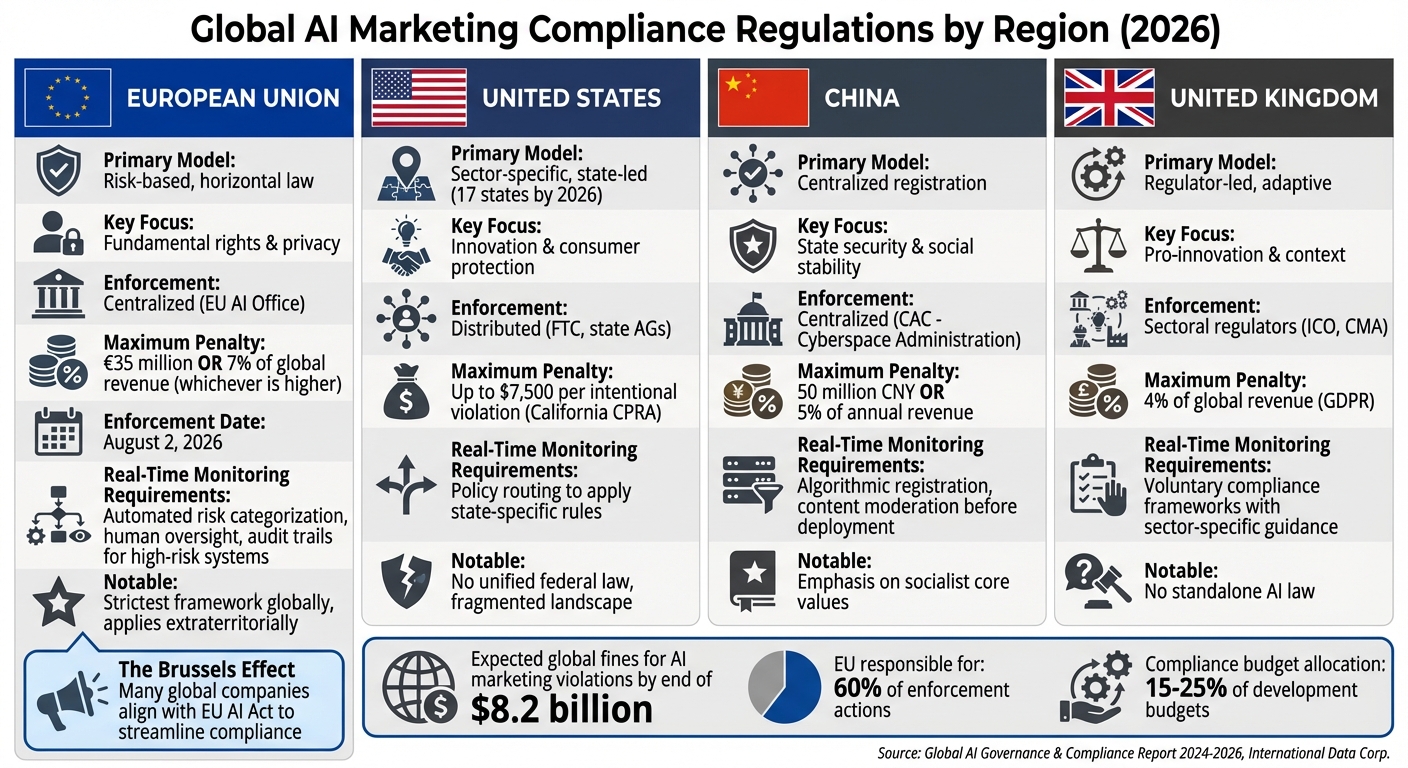
Global AI Marketing Compliance Regulations Comparison 2026
As real-time monitoring technology advances, marketers face the challenge of navigating a complex web of global regulations, each with its own priorities and enforcement strategies. The European Union (EU) stands out with its risk-based AI Act, fully enforceable starting August 2, 2026. This law classifies AI systems into four categories – unacceptable, high-risk, limited risk, and minimal risk – and applies to any company whose AI output is used within the EU, no matter where the business is located [9][10]. Violating prohibited AI practices under this act can lead to fines up to €35 million or 7% of global annual revenue, making it one of the world’s strictest frameworks [9][10].
In contrast, the United States lacks a unified federal AI law, relying instead on a patchwork of state-specific regulations. By 2026, 17 states will have passed AI-focused marketing or privacy laws [12]. For example, California’s CPRA imposes fines of up to $7,500 per intentional violation, while Colorado requires algorithmic impact assessments for high-risk AI systems [11][12]. This fragmented landscape forces companies to develop compliance systems that can adapt to varying state rules rather than depending on a single framework.
China emphasizes state control and content moderation. The Cyberspace Administration of China (CAC) mandates algorithmic registration and adherence to "socialist core values." Non-compliance can result in fines reaching 50 million CNY or 5% of annual revenue [11][13]. Meanwhile, the United Kingdom adopts a "pro-innovation" approach, leveraging existing regulators like the ICO and CMA to provide sector-specific guidance instead of enacting a standalone AI law [11][14]. Despite these regional differences, many global companies are aligning with the EU AI Act to streamline compliance, a trend often referred to as the "Brussels Effect" [11].
"Documentation is the universal currency of AI compliance: without clear records of design, testing, and oversight, regulators will assume you did nothing."
- Global AI Governance Practice Lead, Pertama Partners [11]
The financial stakes are high. By the end of 2026, global fines for AI marketing violations are expected to surpass $8.2 billion, with the EU responsible for nearly 60% of enforcement actions [12]. On top of that, companies allocate 15% to 25% of their development budgets to compliance and regulatory tasks [13]. Real-time monitoring systems play a crucial role in managing these challenges by applying jurisdiction-specific rules – like California’s opt-out requirements or Colorado’s impact assessments – directly into marketing workflows [7].
Regional Regulatory Differences
Here’s a breakdown of how regulations vary by region:
| Region | Primary Model | Key Focus | Enforcement | Max Penalty | Real-Time Monitoring Impact |
|---|---|---|---|---|---|
| European Union | Risk-based, horizontal law | Fundamental rights & privacy | Centralized (EU AI Office) | 7% of global revenue [11] | Requires automated risk categorization, human oversight, and audit trails for high-risk systems [9][10] |
| United States | Sector-specific, state-led | Innovation & consumer protection | Distributed (FTC, state AGs) | $7,500 per violation (CA) [11] | Needs "policy routing" to apply state-specific rules in real-time [7][12] |
| China | Centralized registration | State security & social stability | Centralized (CAC) | 5% of annual revenue [11] | Mandates algorithmic registration and content moderation before deployment [11][13] |
| United Kingdom | Regulator-led, adaptive | Pro-innovation & context | Sectoral regulators (ICO, CMA) | 4% of global revenue (GDPR) [11] | Encourages voluntary compliance frameworks with sector-specific guidance [11][14] |
AI Governance in Marketing Automation
Coordinating global regulations with internal processes is key to ensuring marketing, legal, and technology teams work together effectively. Right now, 82% of enterprise marketing teams use AI tools without a formal governance framework, while 71% of enterprise legal departments identify marketing AI usage as a "high-risk area" [15]. This misalignment often leads to "Shadow AI", where unregulated AI usage exposes companies to fines and other regulatory issues.
On the flip side, enterprises with well-developed AI governance frameworks see tangible benefits. They deploy AI 47% faster and cut compliance review cycles by 62% [15]. Gartner forecasts that by the end of 2026, companies with advanced AI governance will experience 2.5x faster innovation cycles and reduce compliance risks by 40% [15]. These outcomes highlight how integrated governance can drive operational efficiency while meeting regulatory demands.
Coordinating Marketing, Compliance, and Technology Teams
Each department plays a distinct role: marketing drives execution, compliance mitigates risks under regulations like GDPR and the EU AI Act, and technology enforces controls and manages data protocols [16][5]. However, 78% of generic IT-centric AI governance frameworks fail when applied to marketing, as they often can’t keep up with the fast-paced nature of marketing cycles [15].
"Marketing specific AI governance is now a leadership obligation. This is not about slowing innovation. It is about staying in control of how AI shapes brand trust, consumer perception, and regulatory exposure."
- Aby Varma, Spark Novus [16]
A global financial services firm tackled this issue in 2025 by adopting a centralized AI platform with built-in governance. This approach reduced compliance review cycles by 62%, sped up campaign deployment by 47%, and improved brand consistency scores by 31% across more than 40 markets [15]. Their success stemmed from a "guild" model, where Marketing, Operations, Legal, and IT shared responsibility for AI guardrails and blueprints [18].
Clear role definitions also played a critical role. Marketing leaders managed content labeling, compliance teams set guardrails, and technology teams implemented controls. This structure prevents "attribution drift", ensuring all AI actions are traceable and auditable [17][1].
Using AI Maturity Models for Compliance
Structured risk tiers provide a practical way to streamline oversight while speeding up decision-making. AI maturity models help organizations transition from pilot projects to fully operational workflows. These models classify AI use cases into three risk tiers based on the data involved and the decisions made [4]:
| Risk Tier | Data Type | Governance Requirement |
|---|---|---|
| Tier 1 (Low) | Non-personal / Internal | Tasks like ideation and copy editing; no personal data involved. |
| Tier 2 (Medium) | Pseudonymous / Aggregated | Requires strict vendor reviews and mandatory logging of all prompts and outputs. |
| Tier 3 (High) | Identifiable Customer Data | Demands formal privacy reviews, security sign-offs, and detailed documentation. |
This tiered system allows teams to act quickly on low-risk tasks (like brainstorming blog headlines in Tier 1) while applying thorough oversight to high-risk activities (like personalizing pricing offers in Tier 3) [4].
Organizations with high AI maturity often use "AI Workers" instead of generic automation tools. These AI Workers operate within predefined guardrails, follow versioned procedures, and automatically generate audit trails [4][5]. By 2026, regulators will no longer accept excuses like "the model decided" without clear documentation of the data signals and human approvals behind decisions [1].
"If you can describe your marketing workflow, you can govern it."
- Ameya Deshmukh, Everworker [4]
A practical 90-day roadmap starts with identifying AI use cases and defining prohibited phrases. Next, it incorporates consent signals and automated pre-checks, culminating in pilot campaigns documented through comprehensive AI dossiers [5][17].
The benefits are measurable. In Q1 2024, one in five marketing assets flagged for compliance issues was caught before publication, avoiding legal exposure that previously led to $400,000 in SEC penalties for AI-washing in March 2024 [2]. Additionally, a global tech company consolidated over 12 AI tools into a single governed platform, resulting in a 38% drop in brand guideline violations and 55% faster content production cycles [15].
My Rich Brand‘s Approach to Real-Time Marketing Compliance
My Rich Brand combines AI automation with human expertise to ensure marketing efforts are both effective and compliant with regulations. Using a compliance-by-design strategy, the company employs its AIME™ (AI Automated Marketing Ecosystem) framework to balance scale with precision. This system dedicates 80% of its processes to AI-driven execution, while 20% is overseen by experts to ensure accuracy and adherence to regulatory standards [21]. The result is an approach that automates marketing while preserving the "emotional intelligence" necessary for meaningful brand engagement, all within strict compliance guidelines. Below are examples of how these solutions deliver tangible results.
AI-Powered Marketing Services for Compliance
My Rich Brand offers services that combine real-time adaptability with compliance safeguards. Two key offerings, Steady SEO ($499/month) and Growth Ads ($449/month), use AI-driven optimization to monitor engagement and make instant campaign adjustments. This ensures high performance without compromising regulatory compliance [21]. By automating these processes, brands can protect their image and boost ROI simultaneously.
A standout example is Grace Events, owned by Mwika Kaunda, which adopted My Rich Brand’s AI Marketing Automation plan in early 2026. The initiative included a website redesign and an AI chatbot customized for integration with HoneyBook CRM. Within the first 30 days, the chatbot generated over 35 qualified leads, saving more than 15 hours of manual lead-nurturing each week while maintaining the brand’s premium image [19][20]. The chatbot operated within human-defined parameters to ensure interactions aligned with the brand’s voice and compliance standards.
"At My Rich Brand, we blend AI-driven efficiency with human strategy, giving you automated marketing without sacrificing quality or emotional intelligence." – My Rich Brand [21]
Customized Solutions for Business Growth
My Rich Brand also tailors its AI-powered services to meet the unique compliance needs of various industries. For instance, since 2021, the agency has supported Kinki Swim, founded by Marianne Argy, with a full-service ecommerce transformation. The brand’s Shopify store now features AI-powered SEO, automated blogging, and abandoned cart recovery. Additionally, a custom AI chatbot improved customer interactions, leading to a 20% increase in revenue through automated promotions and recovery campaigns [19][20].
This flexible approach allows businesses to begin with "Starter" plans and scale up to "Elite" or "Scaling" tiers as their compliance requirements evolve [22]. These tailored solutions ensure companies can maintain regulatory oversight while achieving consistent growth.
Conclusion
AI-driven real-time monitoring has reshaped marketing compliance, turning it from a frustrating hurdle into a strategic advantage. With AI, marketing teams can create content at a scale that manual reviews simply can’t keep up with. The secret lies in embedding compliance into the content creation process itself – catching risks while drafting instead of scrambling to fix them later.
The stakes are high. Regulators are cracking down on exaggerated AI claims, and the EU AI Act brings the potential for hefty penalties in cases of serious violations. Companies that view compliance as an afterthought risk facing expensive revisions, fines, and damage to their brand’s reputation. A proactive approach ensures a strong compliance framework that supports both quality and growth.
The future belongs to brands that build trust into their operations by combining AI automation with human expertise.
"CMOs who operationalize trust – not just document it – will win on speed and credibility."
- Christopher Good, EverWorker [7]
My Rich Brand’s AIME™ framework is a clear example, blending 80% AI-powered execution with 20% expert oversight. This ensures both speed and precision, while also establishing a reliable audit trail to make compliance a repeatable and scalable process [21].
With tools like real-time monitoring, automated disclosure checks, and centralized audit trails, brands can now move fast without compromising on compliance. The real question isn’t whether to adopt AI for compliance – it’s how quickly you can implement these systems to protect your brand and drive growth in a world of tightening regulations. Striking this balance is the key to thriving in the ever-changing digital landscape.
FAQs
What counts as “high-risk” marketing content for AI compliance?
High-risk marketing content refers to materials like AI-generated text, images, translations, and videos used in sponsored campaigns. Starting in 2026, such content must include double disclosure to meet FTC guidelines. This means marketers are required to clearly disclose both the sponsorship and the involvement of AI in creating the content.
How do real-time compliance tools fit into a fast marketing workflow?
Real-time compliance tools simplify marketing workflows by automating review processes, consolidating approvals, and providing ongoing monitoring. These tools ensure that campaigns align with legal, regulatory, and brand standards without causing delays. By becoming part of everyday operations, they allow teams to launch campaigns faster, cut down on manual checks, and stay compliant across various platforms. This is especially crucial for handling the increasing amount of AI-generated content while avoiding potential bottlenecks and compliance issues.
What should I log to be audit-ready under laws like GDPR and the EU AI Act?
To adhere to regulations like GDPR and the EU AI Act, it’s essential to maintain thorough logs of your AI system’s decision-making process. These logs should capture critical details, including input data, model parameters, decision rationale, and outputs. Make sure these records remain accessible, even after system updates or changes.
Additionally, create and preserve an audit trail for governance practices. This should document policies, enforcement actions, and other measures taken to ensure compliance. Such records are key to demonstrating accountability and transparency during audits or regulatory reviews.