



Behavioral segmentation focuses on grouping customers based on their actions – like purchases, app usage, and website clicks – rather than static traits like age or location. This approach allows businesses to deliver personalized experiences, reduce churn, and improve marketing ROI.
Here’s why it works:
- Lower churn: Identify early signs of disengagement and take proactive steps to retain customers.
- Personalized experiences: Tailor messaging to match individual behaviors, increasing engagement and loyalty.
- Higher ROI: Target high-value segments with precision, leading to better conversion rates and cost efficiency.
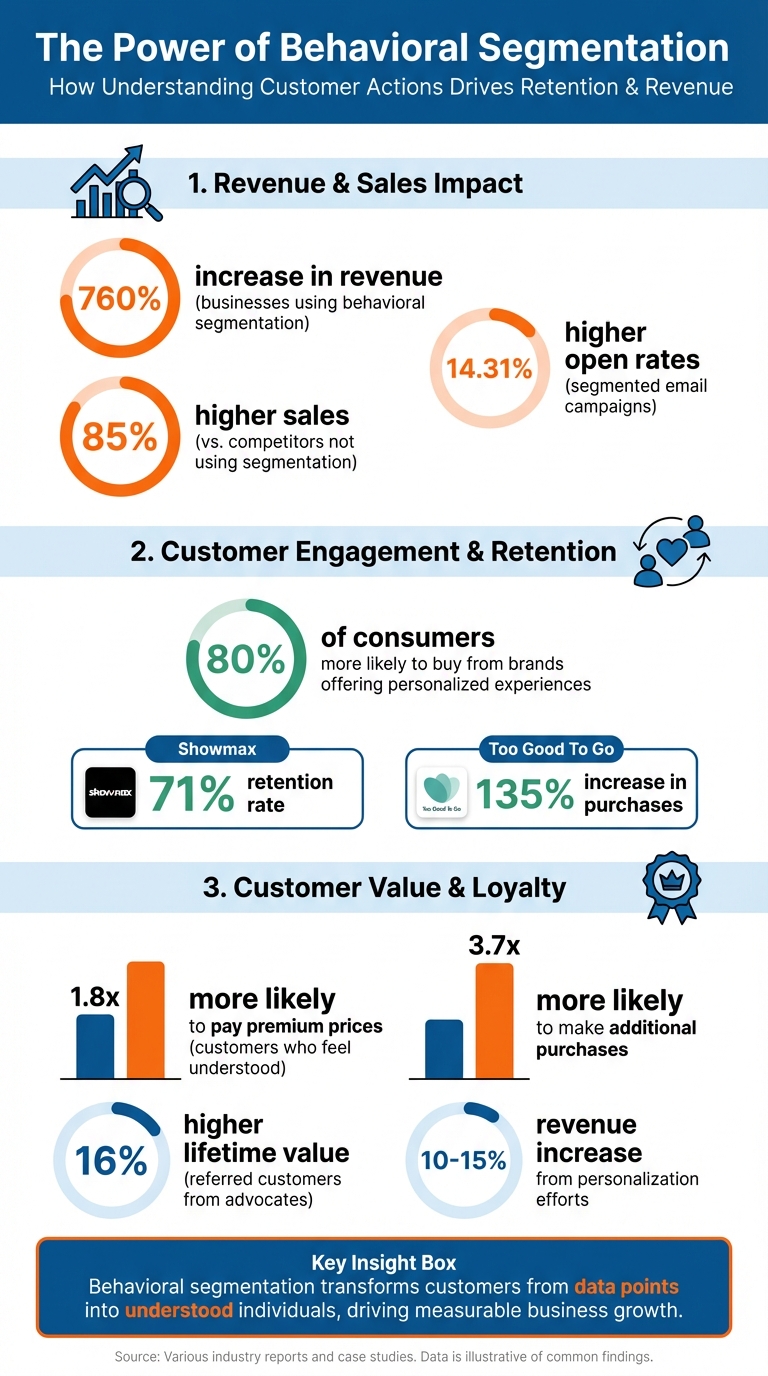
For example, Too Good To Go used behavioral insights to send real-time notifications, boosting purchases by 135%. Similarly, Showmax achieved a 71% retention rate by targeting disengaged users with tailored campaigns.
In today’s market, understanding customer behavior is essential. Start by tracking key actions like purchase history or app usage, and use this data to craft targeted, automated responses. The result? Stronger relationships, better retention, and increased revenue.
Behavioral Segmentation Impact on Customer Retention and Revenue
How Behavioral Segmentation Improves Deliverability and Reduces Unsubs
sbb-itb-c00c5b1
What Is Behavioral Segmentation and Why Does It Matter?
Behavioral segmentation focuses on grouping customers based on their actions – like purchases, clicks, app usage, or email engagement – rather than relying on static demographics. It dives into behaviors such as purchase history, website activity, app interactions, and email open rates.
For example, if someone visits your pricing page multiple times in a week, it’s a strong indicator of purchase intent [6]. On the other hand, a user who hasn’t logged into your app for over a month might be at risk of churning [3].
How Behavioral Segmentation Works
This method involves tracking time-stamped actions to identify patterns in engagement. One common approach is RFM analysis, which evaluates Recency (when the last purchase occurred), Frequency (how often purchases happen), and Monetary Value (total spending) [1].
Take JOBKOREA, a South Korean recruitment platform, as an example. In 2025, they used dynamic segmentation to track user behaviors like job searches, applications, and profile updates. By tailoring their messaging through A/B testing, they achieved a 4-5x increase in click-through rates [4].
"Braze has allowed me to try different things as a CRM manager… being able to configure personalized messages with Liquid, A/B test with color and creative variations, diversify campaigns, and review performance reports without having to ask the development team has made my job more efficient" [4].
- Eunpa Han, CRM Manager at JOBKOREA
This type of segmentation provides actionable insights that directly influence strategies for improving customer retention.
The Connection to Customer Retention
By leveraging behavioral insights, businesses can take proactive steps to prevent churn and build loyalty. For instance, offering exclusive rewards to frequent buyers or providing support to users browsing the help center can address needs in real time and strengthen customer relationships.
The impact of this personalized approach is clear – 80% of consumers are more likely to buy from brands that deliver tailored experiences [5].
A great example of this is Too Good To Go, a food waste reduction platform. In 2025, they used behavioral segmentation to track app sessions and purchase history. They sent real-time notifications about nearby “Surprise Bags” to users who had previously expressed interest. This strategy led to a 135% increase in purchases and doubled their message conversion rates [4]. By responding to actual behaviors instead of assumptions, they successfully turned casual users into loyal customers.
Main Benefits of Behavioral Segmentation for Retention
Lower Churn Rates with Targeted Actions
Behavioral segmentation helps businesses spot early warning signs of customer churn. For instance, if a user hasn’t logged in for a week, skips key features, or reduces their activity, automated alerts can trigger re-engagement efforts [2][8].
A great example is Showmax, a streaming service that segmented its audience by lifecycle stage and content preferences. By identifying disengaged users, they launched targeted re-engagement campaigns. The result? A 71% retention rate and a 12% increase in win-back rates [4]. Instead of waiting for cancellations, they acted proactively to bring users back.
This approach also works for identifying your most loyal customers. By recognizing "Champions" – users who frequently purchase and engage – you can reward them with exclusive perks or VIP programs, increasing their lifetime value [3][6]. These tailored actions are effective because they respond directly to customer behaviors rather than relying on assumptions. It’s about addressing specific needs before they escalate into problems.
Personalized Experiences for Each Customer
Segmentation does more than reduce churn – it elevates personalization. Tailoring experiences to individual preferences helps meet the growing expectations of U.S. consumers [4].
For instance, segmenting by "benefits sought" allows businesses to focus on what matters most to different customer groups, whether it’s convenience, affordability, or prestige [3][6]. Someone frequently visiting your pricing page needs different messaging than a user exploring product features. Using behavioral data in this way can increase sales by up to 85% through timely, relevant communication [3].
The financial impact of personalization is clear. Customers who feel understood are 1.8 times more likely to pay a premium and 3.7 times more likely to make additional purchases [6]. This happens because personalization feels helpful – it anticipates customer needs without being intrusive.
Better Marketing ROI
Behavioral segmentation doesn’t just improve retention; it also makes marketing efforts more cost-effective. Focusing on high-value customer segments boosts efficiency. For instance, businesses leveraging behavioral segmentation have reported a 760% increase in revenue [7][6]. Segmented email campaigns alone achieve a 14.31% higher open rate compared to generic ones [7].
Targeting users who repeatedly view pricing pages can triple conversion rates [3]. This approach ensures that marketing budgets are spent wisely, delivering better return on ad spend (ROAS) across all channels [3][8].
Personalization also contributes to revenue growth, with businesses seeing a 10% to 15% increase in revenue and a 20% to 30% improvement in marketing efficiency [4][7]. Instead of spreading resources thin, businesses can focus on customers whose behaviors indicate they’re ready to purchase, at risk of leaving, or likely to become long-term advocates.
How Behavioral Segmentation Builds Stronger Customer Relationships
Creating Trust by Understanding Customer Needs
Understanding customer behavior goes beyond reducing churn – it’s a powerful way to build trust. When customers feel a brand genuinely understands them, they’re more likely to stay loyal. Behavioral segmentation focuses on actions and habits rather than static demographics, allowing brands to communicate in ways that feel relevant and timely. This approach helps create stronger, more meaningful connections.
In fact, in the U.S., customers who feel understood are 1.8 times more likely to pay a premium [6]. By leveraging behavioral data to address specific needs – like prioritizing convenience, delivering quality, or catering to price-conscious shoppers – brands shift their marketing from being an interruption to becoming a helpful service.
"Behavioral segmentation isn’t about labels, it’s about empathy. It’s how brands learn to see customers not as data points, but as people making choices within real emotional and situational contexts." – Mix Bright [2]
This empathy-first approach strengthens loyalty over time. Instead of sending generic messages, brands can offer personalized support based on a customer’s current situation – whether it’s welcoming new users, re-engaging lapsed ones, or offering timely incentives. By anticipating needs and reducing friction, brands build relationships rooted in trust, not just transactions.
Turning Customers into Brand Advocates
Behavioral segmentation doesn’t just foster loyalty – it can turn loyal customers into enthusiastic advocates. By identifying "Champions" – those highly engaged users who frequently purchase and interact with the brand – companies can cultivate a network of vocal supporters [3]. These advocates often leave glowing reviews, refer others, and provide valuable feedback.
Timing is everything when it comes to recognizing these advocates. For instance, Showmax used behavioral segmentation to tailor messages based on lifecycle stages and individual preferences, resulting in a 204% increase in subscribers and a 71% retention rate [4]. Similarly, Too Good To Go sent automated alerts when nearby "Surprise Bags" became available, driving a 135% boost in purchases tied to their CRM efforts [4].
To transform loyal customers into advocates, brands need to offer timely recognition and meaningful rewards. Exclusive perks, early access to new products, or referral bonuses during peak engagement moments make customers feel valued as insiders. This strategy pays off: referred customers have a 16% higher lifetime value than those acquired through other means [9]. By investing in advocacy, brands not only show appreciation but also spark authentic word-of-mouth marketing, delivering the dual benefits of retaining existing customers and attracting new ones. Behavioral segmentation makes this process seamless, reinforcing its importance in building lasting customer relationships.
Conclusion
Behavioral segmentation transforms retention strategies by focusing on real-time customer actions instead of static demographics. This approach helps brands lower churn rates, deliver personalized experiences, and build genuine customer loyalty.
Businesses leveraging behavioral segmentation report a 760% increase in revenue [7] and outperform competitors in sales by up to 85% [3]. These impressive results stem from the ability to spot at-risk customers early, act on high-intent behaviors in real time, and cultivate loyal advocates who drive organic growth.
When brands take timely, data-driven actions, they not only minimize churn but also strengthen customer loyalty. People want to feel understood – not as mere data points, but as individuals making real-life choices. This connection matters: 80% of consumers are more likely to buy from brands that offer personalized experiences [5]. It’s a clear reminder that relevance and understanding are essential in today’s competitive market.
To get started, focus on a few impactful customer segments like cart abandoners, loyal power users, and at-risk customers. Set specific KPIs for each group, automate responses to behavioral triggers, and revisit your segmentation strategy every quarter to keep up with evolving customer habits. These steps lay the groundwork for sustainable growth while ensuring every interaction feels meaningful.
At My Rich Brand, we believe in the power of behavioral segmentation to create lasting customer relationships. Brands that prioritize personalized, data-driven strategies are setting themselves up for enduring success.
FAQs
What behavioral data should I track first?
To truly understand your customers, pay attention to their actions that signal intent and engagement. This includes monitoring purchase behavior, website interactions, and feature usage. These insights can guide you in crafting marketing strategies that feel more tailored and relevant to your audience. When you know what your customers are interested in and how they interact with your brand, you can connect with them on a deeper level.
How do I spot churn risk from user actions?
Monitoring user behavior can reveal early signs of disengagement or potential churn. Look for indicators such as reduced activity, infrequent logins, abandonment of important workflows, or a drop in feature usage. Other patterns, like fewer purchases or extended periods of inactivity, may also signal a risk. Spotting these trends early gives businesses the chance to take action, re-engage users, and boost retention efforts.
How often should I update my segments?
To keep your strategies aligned with current trends and customer needs, it’s important to update your segments on a regular basis. Adjustments should be made frequently – ideally in real-time or at least monthly – to reflect shifts in customer behaviors effectively.