




AI is transforming how businesses maintain brand consistency, especially as they grow and manage diverse teams, channels, and content. Without consistent branding, companies risk losing millions annually due to customer confusion, trust erosion, and operational inefficiencies. Here’s how AI tackles these challenges:
- Real-time brand compliance: AI converts static brand guidelines into active, machine-readable rules, flagging issues like incorrect colors, logos, or tone before content goes live.
- Faster review cycles: AI reduces manual review times from hours to minutes, improving efficiency by up to 98%.
- Revenue impact: Consistent branding can increase revenues by 10–23%, while inconsistent branding costs companies millions annually.
- Personalized, on-brand content at scale: AI generates and monitors content tailored to platforms while ensuring alignment with brand standards.
- Continuous monitoring: AI tracks brand perception, sentiment, and compliance across platforms, providing actionable insights to protect and optimize brand identity.
AI isn’t replacing creativity but streamlining repetitive tasks, enabling teams to focus on strategy while maintaining a unified brand presence. Businesses using AI for brand consistency report higher revenue growth, improved efficiency, and stronger customer trust.
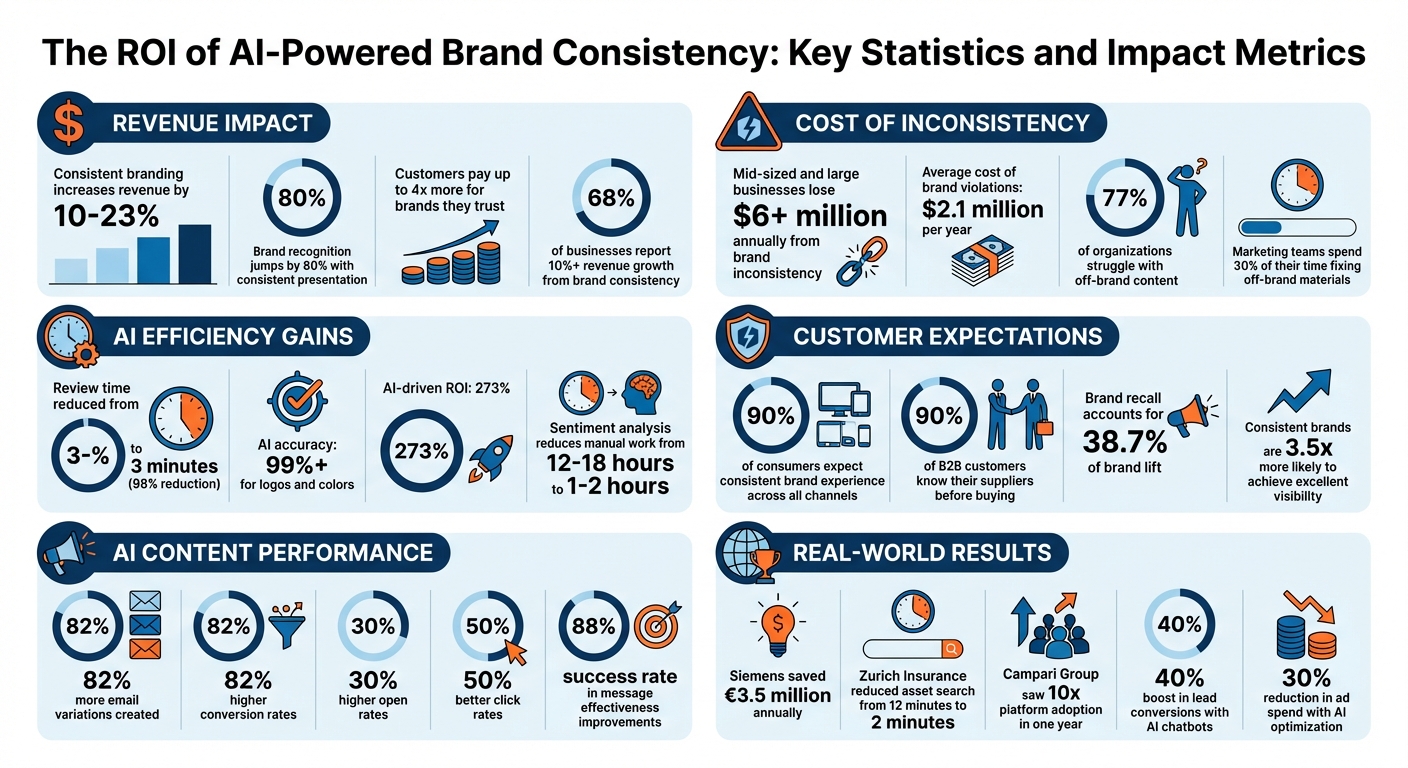
The ROI of AI-Powered Brand Consistency: Key Statistics and Impact Metrics
Bring Consistency to Your Brand Voice with AI
sbb-itb-c00c5b1
Why Brand Consistency Matters for Business Growth
Brand consistency is a game-changer when it comes to driving revenue. Research shows that presenting your brand consistently across all platforms can boost revenue by 10–23% [1][8]. Why? Because people trust what they know. When customers encounter the same colors, fonts, and messaging across every interaction with your brand, recognition jumps by up to 80% [2].
This familiarity isn’t just comforting – it’s profitable. A whopping 90% of consumers expect a consistent brand experience across all channels [4]. When you meet that expectation, you earn their trust on a deeper level, often beyond rational decision-making. Customers who feel a strong connection to your brand are willing to pay up to four times more [2]. This kind of loyalty shifts your business from competing on price to competing on value, creating a solid foundation for long-term growth. The numbers don’t lie: brand consistency drives measurable revenue gains while highlighting the steep costs of getting it wrong.
The stakes are even higher in B2B markets. Here, 90% of customers already know which suppliers they’ll consider before their buying journey even begins [2]. If your brand isn’t consistently visible and memorable at every touchpoint, you’re likely not even in the running. Brand recall, which is the biggest driver of brand lift, accounts for 38.7% of that lift [3]. In other words, being remembered is half the battle – and consistency is how you win.
The Cost of Inconsistency
On the flip side, inconsistent branding can cost businesses millions in lost revenue every year. Why? Because inconsistency confuses customers and erodes trust. If your logo appears in different colors on different platforms or your messaging feels disjointed, customers may start questioning your reliability. In contrast, brands that maintain consistency are 3.5 times more likely to achieve excellent visibility [11].
But it’s not just about lost sales. Operational inefficiencies also pile up. Inconsistent branding leads to rework, longer review cycles, and constant scrambling to fix errors. With 77% of organizations admitting they struggle with off-brand content [1], this isn’t just a minor hiccup – it’s a widespread issue that demands attention.
The Challenges of Scaling Branding Efforts
As businesses grow, keeping branding consistent becomes increasingly difficult. What works for a small, centralized team often breaks down when you’re managing freelancers, agencies, and regional teams spread across time zones.
One major issue is channel silos. Social media teams focus on engagement, email teams aim for conversions, and product teams prioritize functionality. While each team may excel in its area, their decisions can fragment your brand’s overall voice [8]. Add in a distributed workforce – freelancers and agencies who often lack the full picture and rely on guesswork instead of formal guidelines – and the problem only grows [6].
Speed is another complicating factor. Faster production cycles often mean skipping important review steps, leading to what experts call “unprecedented quality drift” [7]. Legacy tools like PowerPoint or Google Slides make it easy to override established brand rules, further compounding the issue [1].
Take Telefónica’s example. In 2025, the company implemented a centralized brand management system to handle its sub-brands across 16 global markets. Account Manager Cristina Terrón Moreno highlighted the benefits: “Being able to manage all brand materials and workflows at the same time in one unique space for all countries and brands is the main benefit and a milestone” [9].
These challenges underscore the need for automation. As your brand scales, systems that enforce consistency automatically – rather than relying on manual oversight – become essential.
| Challenge | Impact on Brand Consistency |
|---|---|
| Channel Silos | Teams make platform-specific decisions, fragmenting the brand [8]. |
| Distributed Workforce | Freelancers and agencies often lack context, relying on intuition [6]. |
| Speed-Driven Production | Faster cycles lead to skipped reviews and quality issues [7]. |
| Legacy Tools | Traditional tools allow brand guidelines to be easily ignored [1]. |
The solution isn’t to slow down or add more layers of review. Instead, businesses need systems that ensure consistency automatically. This is where AI can step in and make a real difference.
How AI Solves Brand Consistency Problems
AI offers a game-changing approach to addressing brand consistency challenges. Instead of relying on outdated PDFs or manual processes, AI transforms static brand guidelines into machine-readable formats like JSON or "brand tokens." These formats allow software to enforce rules in real time, turning passive guidelines into active safeguards. This shift not only automates tedious tasks but also prevents mistakes before they happen, creating a system that actively protects your brand identity [4][14].
The impact is staggering: AI-powered tools can reduce manual review time from 3–6 hours to just 3 minutes, cutting review efforts by 98% [13]. With 99%+ accuracy in detecting issues like incorrect logo placement or color usage, AI eliminates human errors caused by fatigue or subjective judgment [13]. Considering mid-sized and large businesses lose over $6 million annually to brand inconsistency [9], these tools directly safeguard your revenue.
But AI isn’t just about speed. It shifts the focus from reactive audits to proactive governance. Think of it as a "spellcheck" for your brand’s visual and written identity. As designers and writers create content, AI continuously monitors for compliance, flagging issues in real time. This approach ensures that maintaining brand integrity becomes a seamless part of the creative process [9].
AI for Visual and Tone Consistency
AI leverages computer vision and rule engines to enforce visual consistency. It checks everything from hex color codes and logo spacing to typography and imagery style [13]. If someone uses the wrong shade of green or places a logo incorrectly, AI flags the issue instantly. As The Pedowitz Group explains, AI essentially understands your brand’s "visual DNA" and ensures compliance at scale [13].
For written content, AI acts as a "voice detector", analyzing word choice, tone, and emotional cues to ensure alignment with your brand’s personality. Advanced natural language processing (NLP) tools can even adapt your voice for different platforms. For example, an executive email might lean formal, while a customer support reply stays warm and empathetic – all while maintaining the core brand identity [15]. AI also enforces hard rules, flagging banned terms, competitor mentions, or missing legal disclaimers that could otherwise slip through the cracks.
This combination of visual and tone compliance ensures every piece of content – whether visual or written – meets your brand standards before it goes live.
Real-Time Compliance and Governance
Real-time compliance is where AI truly stands out. By integrating directly into content management systems, design tools, and digital asset platforms, AI monitors assets during creation [16][14]. Instead of waiting for post-creation audits, AI provides immediate, actionable feedback. For example, rather than vague comments like "this doesn’t feel right", AI offers precise instructions such as "replace hex #004963 with #0066CC" or "increase logo spacing by 0.25 inches" [13][10].
For AI-generated content, the system can refine its own prompts until the output meets your brand standards, creating an iterative process that ensures compliance without human intervention [10]. The most advanced systems even include pre-publish gates, preventing off-brand content from going live. These tools automatically flag questionable material for human review only when necessary, streamlining the entire workflow [13][9].
"Brand Agent transforms your static brand guidelines into dynamic, intelligent rules that work directly within your content workflow." – Saachi Shah, Product Manager at Typeface [14]
| Feature | Manual Review | AI-Powered Review |
|---|---|---|
| Review Time | 3–6 hours per asset | ~3 minutes per asset |
| Accuracy | Inconsistent/error-prone | 99%+ for logos/colors |
| Scalability | Limited by headcount | Unlimited across thousands of pages |
| Feedback | Delayed (post-creation) | Real-time (during creation) |
AI also adapts to platform-specific requirements. For instance, your tone on LinkedIn will naturally differ from a formal email, and AI applies these nuances automatically [14][9]. This contextual understanding ensures your brand stays consistent while tailoring its approach to fit each platform. By combining real-time compliance with platform-specific governance, AI provides the comprehensive tools needed to maintain a cohesive brand presence across all channels.
AI-Powered Content Creation and Personalization
AI isn’t just about managing real-time processes; it’s also reshaping how companies create and personalize content – all while staying true to their brand identity.
AI makes it possible to produce personalized content at scale without compromising consistency. Businesses can now generate thousands of variations of content that align perfectly with their brand guidelines. How? Through centralized Brand Hubs that store machine-readable rules like hex codes, typography standards, logos, and tone-of-voice parameters. These hubs act as the single source of truth for all AI-generated assets, ensuring every piece meets brand standards [19][3][17].
For example, Salesforce saw a massive boost in performance by leveraging AI. They created 82% more variations of nurturing emails, leading to 82% higher conversion rates, 30% higher open rates, and 50% better click rates than their previous methods [2]. This success came from a process called "data-driven hydration", where AI combined customer data with brand assets to insert tailored insights into pre-approved templates [19].
To maintain quality, automated systems review AI-generated text and visuals in real time, flagging any deviations from brand guidelines [19][10][12]. AI refines its outputs through 3-5 iterative cycles, tweaking details like "use hex color #184F35 for all green elements" until the final product aligns perfectly with brand requirements [10].
Creating On-Brand Assets with AI
Generative AI can create images, videos, and written content by learning from your existing high-quality materials. By training on curated examples, the system understands your brand’s unique style – whether it’s visual textures, lighting, or tone – so new content fits seamlessly with your identity [3][12]. This eliminates the need for complex prompt engineering because the AI already knows what "on-brand" means.
Locked templates play a crucial role by protecting essential elements like logos, legal disclaimers, and key messaging while allowing room for creative variations [9][18]. Advanced tools like "image harmonization" and "product preservation" ensure that AI-generated visuals blend naturally with real product photography, maintaining a professional look at scale [3].
AI’s capabilities extend to video content as well. Using keyframe sampling, the system ensures consistent placement of brand elements, such as logos, throughout a video. This multimodal analysis catches issues that would take hours for humans to identify, completing the review process in just minutes [10].
Once the assets are perfected, AI ensures they retain their quality and consistency across every channel.
Consistency Across Multiple Channels
AI doesn’t stop at creating content – it also ensures your brand voice remains consistent across platforms. By codifying channel-specific sub-voices, AI adapts your messaging for different platforms while preserving your core identity [18]. For instance, LinkedIn posts may require a professional tone, while TikTok content might lean toward casual and engaging. AI adjusts these nuances automatically, ensuring the underlying brand values remain intact.
This matters because 81% of consumers ignore generic ads, but 45% are open to sponsored content if it feels relevant [19]. AI bridges this gap by tailoring messages to each platform’s style while keeping the core message consistent [19][18]. Automated tagging with brand-specific taxonomy ensures every asset – be it a social media post, email, or landing page – uses approved templates and metadata [9].
"Manage all brand materials and workflows at the same time in one unique space for all countries and brands is the main benefit and a milestone." – Cristina Terrón Moreno, Account Manager, Telefónica [9]
With nearly 75% of marketers now using AI for ad creation, including video and image assets [19], this technology has become essential. Personalization has always been a challenge at scale – 96% of marketers say personalized experiences drive sales [2] – but AI makes it possible to deliver tailored content without losing brand consistency.
This seamless approach to content creation paves the way for real-time monitoring and optimization, ensuring your brand stays ahead in a competitive market.
Real-Time Monitoring and Brand Optimization with AI
Consistently producing content is just one part of the equation. To truly maintain a strong brand presence, you need to monitor continuously and make quick adjustments to prevent small issues from growing into big problems. AI makes this possible by offering real-time tracking of brand health and recommending timely improvements.
In the past, brand monitoring relied heavily on manual audits, which could take weeks or even months to complete. By the time inconsistencies were identified, customer trust might already have taken a hit. AI changes the game by scanning platforms in real time, catching issues as they arise, and suggesting solutions based on live performance data. This ensures that every digital interaction aligns with your brand’s identity, extending the proactive governance strategies discussed earlier.
Sentiment Analysis and Brand Perception
AI doesn’t just monitor – it interprets. Beyond tracking mentions, it analyzes how people perceive your brand across various conversations. While traditional tools focus on social media or review sites, modern AI tools also query Large Language Models like ChatGPT, Claude, and Perplexity to see how your brand is being discussed or recommended in private chat settings [20][21]. This is a big deal because, by 2026, AI-generated organic search traffic is expected to hit 30% [25]. This means a growing portion of your audience will discover brands through AI recommendations rather than traditional search engines.
These tools go deeper than counting mentions. They analyze sentiment and context to determine whether your brand is viewed as "premium", "budget-friendly", or something else entirely. They also track which competitors are mentioned alongside your brand, offering insights into your market positioning. If sentiment shifts negatively or your brand stops appearing in top recommendations, AI sends automated alerts to your team [20].
"Brand reputation management without LLM monitoring is like running SEO without tracking rankings – you’re operating blind in a channel that directly impacts your bottom line." – Sight.ai [20]
AI-driven sentiment analysis dramatically cuts down the time needed to refine messaging – reducing manual work from 12–18 hours to just 1–2 hours [24]. This speed allows teams to respond to perception changes before they impact revenue. In fact, 68% of business professionals report that using these methods to maintain brand consistency has boosted their revenue growth by 10% or more [23].
Predictive Adjustments for Campaigns
AI doesn’t stop at identifying problems – it predicts them and offers actionable solutions. By analyzing data from social media, customer reviews, and support transcripts, AI can detect subtle shifts in tone or topic that might lead a campaign to underperform [24]. It even recommends specific adjustments, such as tweaking headlines or calls-to-action, to ensure messaging resonates with your audience [24].
For instance, if AI notices that a particular message generates negative feedback on LinkedIn but performs well on Instagram, it can suggest platform-specific changes while keeping your brand voice intact. This sentiment-based adaptation has shown an 88% success rate in improving message effectiveness, with some changes leading to an 82% boost in brand perception [24].
AI also acts as a watchdog for your digital assets, scanning the web to flag outdated, off-brand, or unauthorized content [22]. This vigilance protects brand equity, preventing violations that could cost businesses an average of $2.1 million annually in missed opportunities [4].
Another key benefit is identifying content gaps – areas where AI models fail to include your brand in relevant queries [20][21]. By addressing these gaps with targeted, authoritative content, you can improve your "AI visibility" and ensure your brand stays part of the conversation. This marks a shift from traditional SEO strategies to focusing on AI SEO tools and AI-driven recommendations [20][21].
With real-time monitoring and predictive tools in place, businesses can move from merely reacting to issues to optimizing their brand proactively. Combined with automated compliance and AI-powered content creation, these strategies ensure your brand remains consistent and impactful across all channels.
My Rich Brand‘s Approach to AI-Driven Brand Consistency
At My Rich Brand, the focus is on blending the precision of AI with the nuance of human expertise to maintain brand consistency on a large scale. Their service model relies on a combination of AI automation and expert input to ensure every customer interaction reflects the brand’s identity. Central to this approach is AIME™ (AI Marketing Ecosystem), a system that integrates AI-driven SEO, social media, advertising, and sales funnels into one cohesive platform. The process follows an 80/20 model: AI handles 80% of tasks like drafting and scheduling, while human experts refine the final 20% to guarantee everything aligns with the brand’s core message [27].
AI-Powered Brand Guidelines Automation
Everything starts with a deep dive into the client’s brand story. This step identifies the unique narrative and key messages that define the brand [26]. These insights are then embedded into AI systems, ensuring that every piece of content – whether it’s an SEO article, a social media post, or ad copy – carries the same consistent voice and message.
AI chatbots also play a major role, managing lead capture, qualification, and up to 75% of customer inquiries around the clock. This ensures a seamless, branded experience for customers while saving time and resources. The results speak for themselves: clients have reported a 40% boost in lead conversions without compromising brand identity [27].
This automated system doesn’t just stop at content creation – it extends across all digital channels, ensuring a consistent presence everywhere.
Integrated Services for Scalable Branding
My Rich Brand doesn’t treat SEO, advertising, and web design as separate entities. Instead, they use AI to connect these areas, creating a unified online presence that reflects the brand’s identity [26]. For example, their AI-powered SEO service produces 2–8 optimized articles each month, while social media automation schedules 28 posts that maintain a consistent look and tone. On the advertising side, AI tools optimize ad spend across platforms like Google, Facebook, and Instagram, cutting costs by 30% and speeding up campaign execution by 50% [27].
This integrated system ensures that every aspect of a brand’s digital presence works together. Regular analytics and insights help fine-tune strategies over time, keeping the brand performing at its best.
Building Long-Term Strategies with AI Automation
AI’s ability to monitor in real time lays the foundation for long-term strategies that keep brand management evolving. Instead of relying on outdated PDFs or static guidelines, brands are now adopting what’s known as a "Living Brand Operating System" [28]. This system integrates strategy, design, and culture into a single, adaptable resource that teams can access and use instantly.
The financial impact of brand inconsistency is massive, costing businesses millions each year [28][9]. On average, marketing teams spend 30% of their time searching for assets, redoing work, or fixing materials that have gone off-brand [28]. AI automation tackles these inefficiencies by preserving institutional knowledge, ensuring that the brand remains consistent even when key team members leave [12].
Centralized Dashboards for Team Collaboration
Centralized dashboards offer real-time insights into brand health, helping leaders monitor progress and catch "brand drift" before it becomes a costly problem [7]. For example, in September 2025, Telefónica – a global telecommunications company – introduced a centralized brand management platform. This tool aligned its sub-brands across 16 global markets, allowing regional teams to create localized campaigns while maintaining global consistency [9].
These dashboards eliminate time-wasting activities like searching for documents or holding lengthy briefing calls. When brand rules are encoded into software, every team member operates from the same, up-to-date source [29]. Tools like Figma, Slack, Google Drive, and Notion can sync seamlessly with these dashboards, cutting down on version conflicts [29][9].
This kind of centralization also sets the stage for AI systems that adapt and improve over time.
Continuous Learning and Adaptation
AI systems don’t just enforce brand rules – they evolve. By analyzing patterns in approved content, assets, and guidelines, these platforms become increasingly adept at understanding your brand’s voice and visual style as your business grows [12][3]. This continuous learning ensures that your branding stays sharp and relevant.
Think of AI-driven branding as a dynamic system that benefits from regular reviews and adjustments based on actual performance and market trends [8]. Automated cycles, typically involving 3–5 iterations, allow AI to self-correct content until it aligns perfectly with brand standards. Human oversight remains crucial for strategic messaging and ensuring top-notch quality [10][5][3].
"AI isn’t here to replace creative professionals; it’s here to empower them by handling tedious compliance work." – Max Mabe, VP Product Marketing, Aprimo [12]
Conclusion
AI is reshaping brand management, and the numbers speak for themselves: brand dilution costs surpass $6 million annually, consistent branding can boost revenue by 10–20%, and AI-driven solutions deliver an impressive 273% ROI[9][1][30].
By shifting from manual processes to automated governance, companies are reclaiming time and resources. For example, Siemens saved €3.5 million annually, while Zurich Insurance reduced asset search times from 12 minutes to just 2 through automation[30]. These gains underscore how automated systems can streamline operations and strengthen brand consistency.
True brand consistency starts with solid governance – not just creating more content. Tools like machine-readable guidelines, centralized asset libraries, and AI-powered compliance checks provide a scalable foundation while safeguarding brand integrity. When Campari Group adopted AI-enhanced workflows in 2025, they saw a 10x boost in platform adoption within a year[30].
The focus has shifted from producing large amounts of content to ensuring quality and consistency at scale. AI doesn’t replace human creativity – it enhances it. By automating repetitive compliance tasks and preserving institutional knowledge, AI frees teams to concentrate on strategic initiatives rather than routine fixes. This proactive approach to governance is key to maintaining brand integrity as businesses grow.
As your brand expands, AI ensures every interaction reflects your core identity – across teams, markets, and channels. For businesses aiming to scale without compromising their brand, AI-powered automation is the difference between controlled, consistent growth and costly missteps.
FAQs
What should I automate first to improve brand consistency with AI?
Start by streamlining how you manage approved brand assets, such as logos, templates, and visuals. AI-driven digital asset management (DAM) systems make it easier by centralizing access to these resources. This ensures teams can consistently use the right assets across various channels, cutting down on confusion and minimizing branding inconsistencies. The result? A unified brand identity that’s easier to maintain, even as your business grows.
How do you turn brand guidelines into machine-readable rules?
To make brand guidelines compatible with AI, you need to convert them into detailed, structured rules that machines can understand. This means breaking down elements like voice, tone, visual standards, and terminology into formats that AI systems can interpret and apply.
Here’s how it works:
- Define and encode standards: Clearly outline your brand’s voice, tone, and visual identity, then load these specifications into AI tools. This can include rules for logo placement, color schemes, and approved fonts.
- Automated validation: Use tools that automatically check for spelling accuracy, tone consistency, inclusivity, and compliance with brand standards.
- Encode visual rules: Digitally specify how visual assets, such as logos and imagery, should be used to prevent misuse or distortion.
- Set up guardrails: Implement policies within AI systems to flag or restrict outputs that deviate from brand guidelines. For high-stakes content, require human approval before publishing.
By combining structured rules with automation and human oversight, you ensure that your brand identity remains consistent across all platforms and channels.
How can AI enforce consistency without limiting creativity?
AI plays a dual role in maintaining brand consistency and encouraging creativity. It acts as a set of "smart guardrails" by embedding a brand’s voice, tone, and style into clear guidelines. This ensures that content stays aligned with the brand’s identity while still allowing room for creative expression. For instance, AI might lock in essential elements like specific colors, fonts, or key terminology, but leave flexibility in areas like messaging or design. This balance lets brands produce content at scale without sacrificing what makes them distinctive.