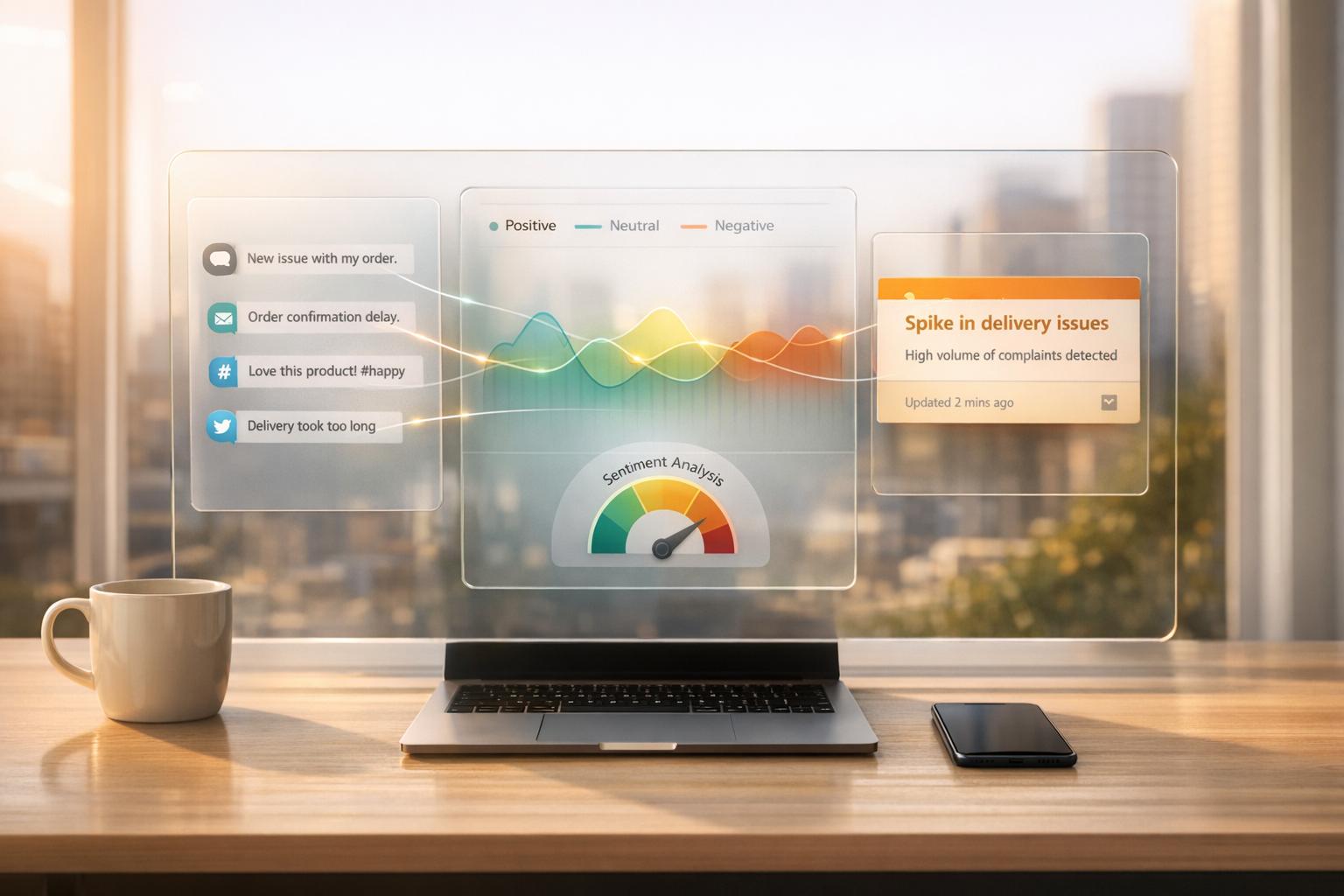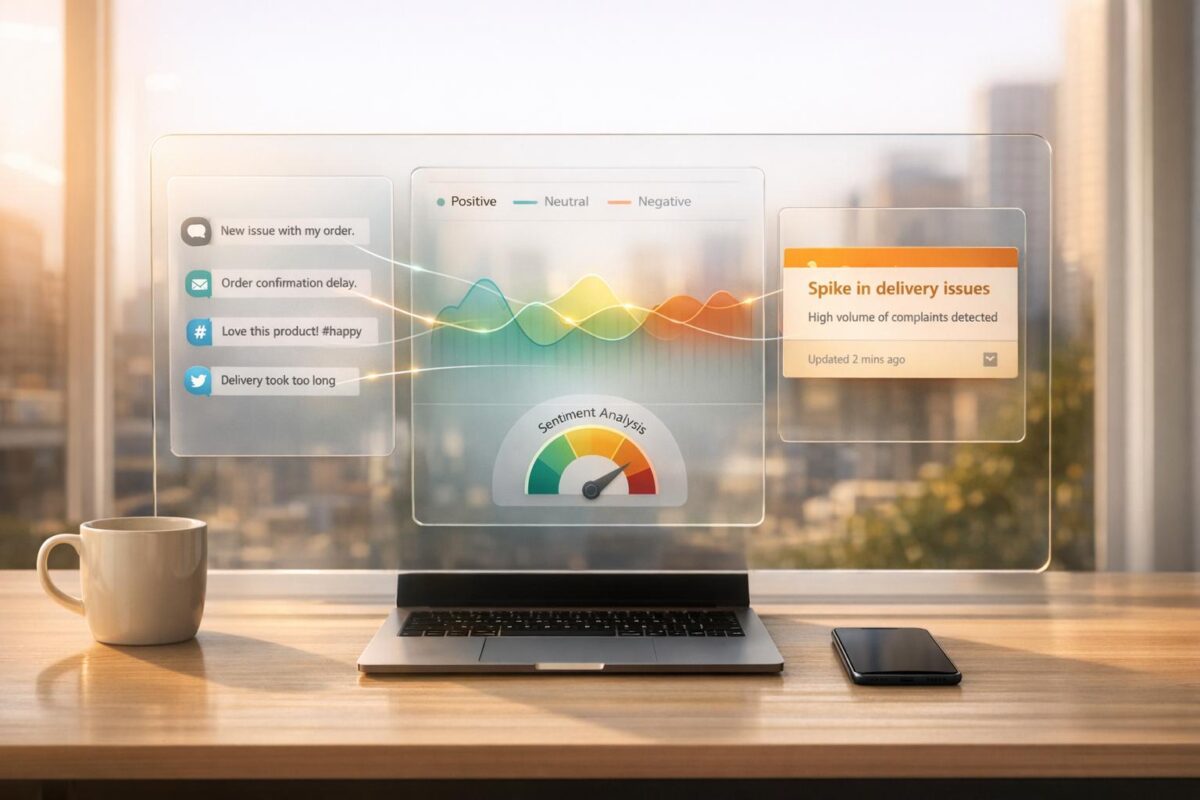



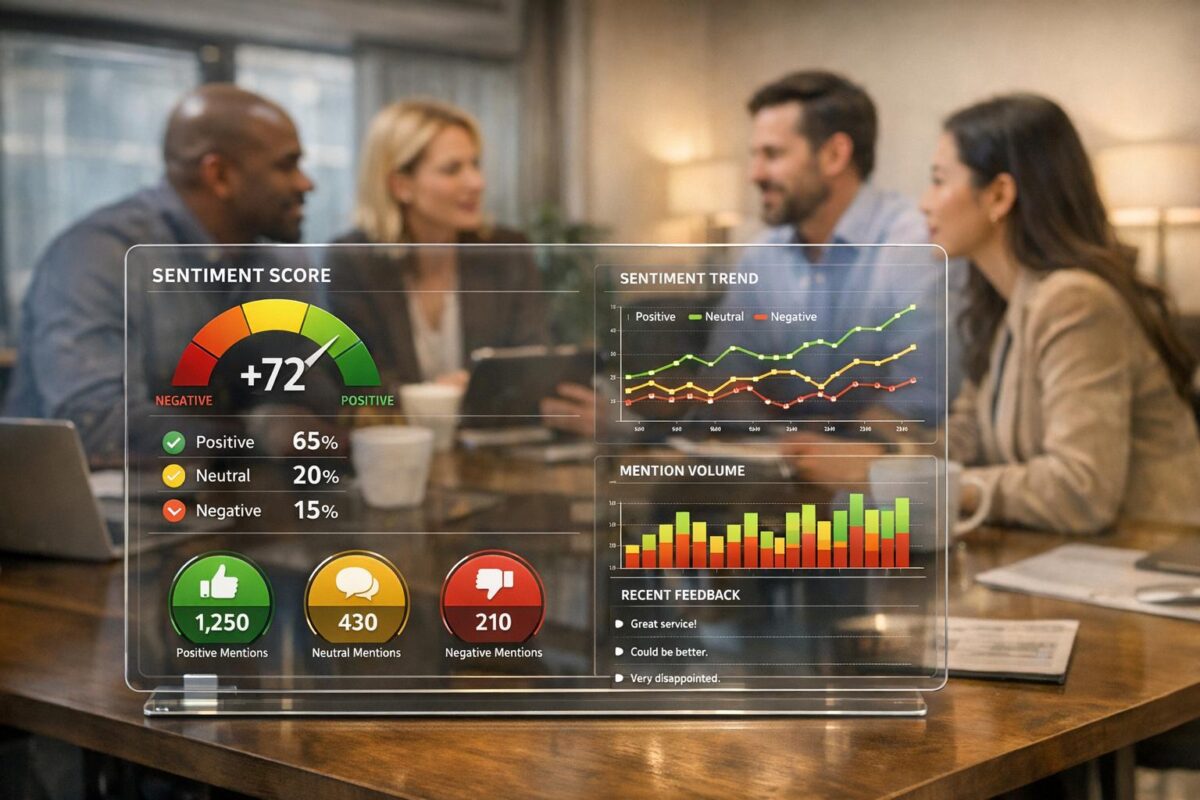
Real-time sentiment analysis helps businesses understand customer emotions instantly. By analyzing feedback from social media, emails, chats, and calls, companies can classify interactions as positive, negative, or neutral within seconds. This allows them to respond faster, improve customer experiences, and prevent potential issues from escalating.
Key takeaways:
- Immediate insights: Unlike delayed surveys, this method processes 100% of customer feedback instantly.
- Improved outcomes: Businesses using this tool see faster resolutions (e.g., James Villas reduced resolution times by 51%) and higher customer satisfaction (e.g., Glammmup improved scores from 68 to 82).
- Broad applications: It’s used in customer support, social media, marketing, and product development.
With the market projected to grow from $3.8 billion to $8.9 billion by 2027, adopting this approach is becoming essential for businesses aiming to stay competitive.
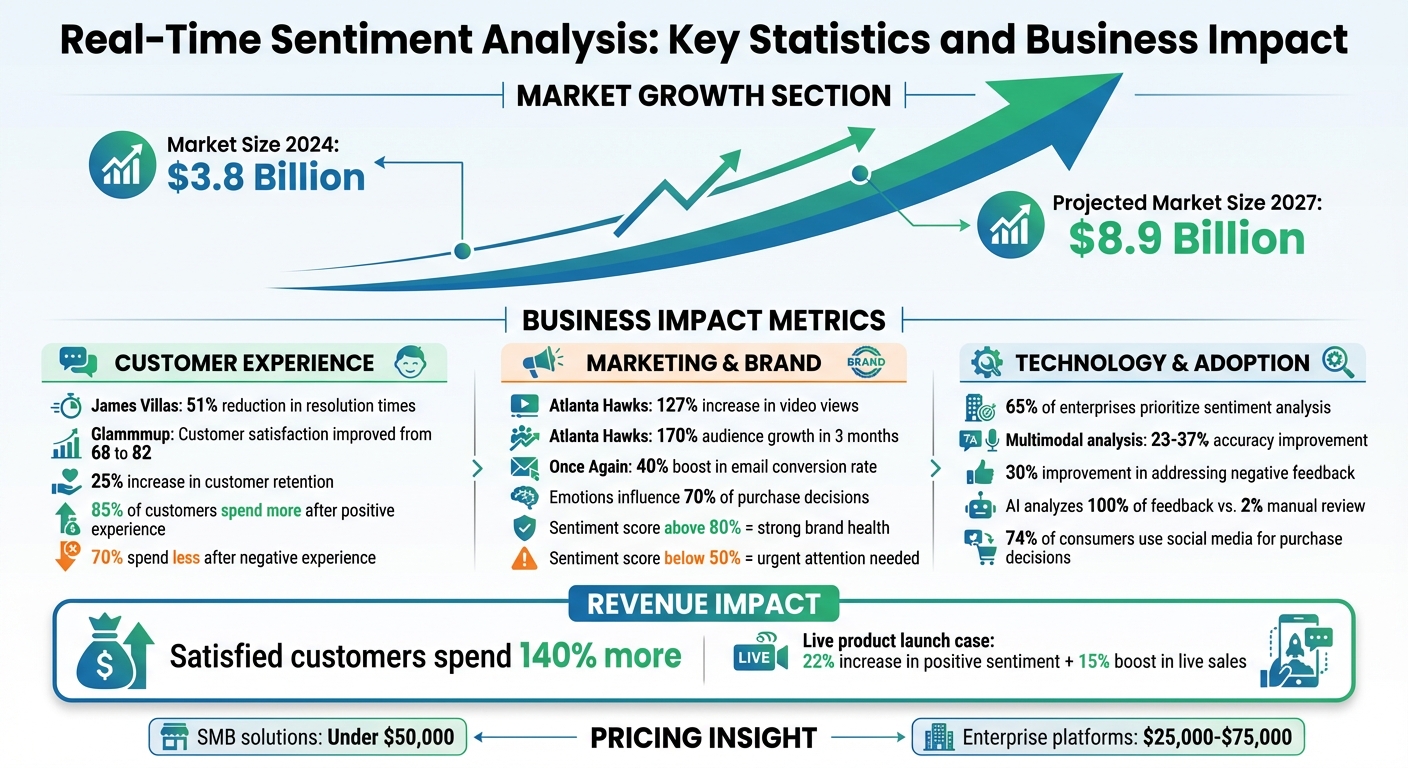
Real-Time Sentiment Analysis: Key Statistics and Business Impact
Build a Real-Time Sentiment Monitor for Customer Reviews with Python & AI
sbb-itb-c00c5b1
Benefits of Real-Time Sentiment Analysis
Real-time sentiment analysis offers three key advantages: improved customer experiences, better brand management, and quicker crisis response. Here’s how these benefits translate into actionable results.
Better Customer Experience
When you can analyze sentiment as interactions unfold, it opens the door to more meaningful and responsive customer experiences. By detecting emotional cues in real time, businesses can personalize interactions on the spot. For instance, if a customer expresses frustration, a chatbot or agent can immediately adjust their tone and approach.
The numbers back this up. James Villas reduced issue resolution times by 51% by using sentiment analysis tools that flagged high-frustration calls for immediate attention [2]. Similarly, Once Again, a second-hand retailer in France, boosted its email conversion rate by 40% by identifying dissatisfaction trends and fine-tuning its engagement strategy [7].
Real-time sentiment tools also offer live coaching prompts for agents, helping them handle challenging conversations with empathy. This not only improves escalation handling but also cuts operational costs [2]. Companies using these tools report a 25% increase in customer retention [2][4], which is crucial given that 85% of customers spend more after a positive experience, while 70% spend less after a negative one [6].
These immediate adjustments not only enhance individual interactions but also lay the groundwork for stronger brand management.
Stronger Marketing and Brand Management
Real-time sentiment analysis revolutionizes how brands manage marketing campaigns and protect their reputation. Instead of waiting for post-campaign data, you can monitor audience reactions as they happen and tweak messaging in real time if sentiment dips [1]. Considering that emotions influence 70% of purchase decisions, this capability is a game-changer [5].
Take the Atlanta Hawks basketball team, for example. By leveraging sentiment analysis to refine their social media strategy, they achieved a 127% increase in video views and grew their audience by 170% in just three months [8]. Beyond social media, tracking untagged brand mentions on forums and review sites allows businesses to seize opportunities or address problems before they escalate [5].
Sentiment analysis also sharpens pricing strategies. By analyzing customer feedback on pricing, businesses can adjust to reduce negative reactions [3]. It even helps vet potential influencer partnerships by evaluating the emotional tone of their audience [3]. This tool doesn’t just measure what customers say – it uncovers how they feel about their experiences [3].
For context, a sentiment score above 80% is a sign of strong brand health, while scores below 50% highlight areas needing urgent attention [5]. Monitoring competitors’ sentiment can also reveal market gaps and opportunities to differentiate your offerings [3][5].
These insights enable brands to respond swiftly to emerging challenges, making sentiment analysis an essential tool for risk management.
Faster Decision-Making and Risk Management
Speed is critical when addressing customer concerns or managing potential crises. Real-time sentiment monitoring helps identify negative sentiment spikes early, preventing them from snowballing into larger public relations issues [5][8]. By flagging urgent feedback, companies can address problems quickly, preserving customer relationships and avoiding churn [2].
For example, PayPal uses AI-driven sentiment analysis to gauge customer emotions in real time, allowing for immediate adjustments to service strategies and agent responses during live interactions [7]. In industries like financial services, sentiment analysis is used to monitor employee communications, catching compliance issues before they escalate into costly penalties [9].
The benefits go beyond crisis prevention. Real-time data enables marketers to fine-tune campaigns by region or demographic group on the fly [8]. Currently, over 65% of enterprises prioritize sentiment analysis to understand customer emotions in digital interactions [10]. Multimodal sentiment analysis, which combines text, voice, and visual cues, further enhances accuracy by 23% to 37% compared to single-mode methods [10].
When sentiment scores fall into critical ranges, having predefined response plans can make all the difference. Automated alerts and protocols for low sentiment scores allow companies to act swiftly [5]. By linking sentiment data with traditional metrics like Net Promoter Score (NPS) and Customer Satisfaction (CSAT), businesses gain a fuller picture of brand health and its impact on financial performance [2].
Technologies Behind Sentiment Analysis
Real-time sentiment analysis relies on three key technologies: Natural Language Processing (NLP), machine learning algorithms, and real-time data processing tools. Together, these technologies work seamlessly to capture and interpret customer emotions as they happen.
Natural Language Processing (NLP)
NLP transforms unstructured text from sources like social media, chat logs, and customer support tickets into structured, analyzable data. As Elastic puts it, "Sentiment analysis is a subcategory of natural language processing, meaning it is one of the many tasks that NLP performs" [11].
The process starts with ingesting raw data, followed by preprocessing steps like tokenization, stop word removal, and lemmatization. Next comes feature extraction, using methods such as TF-IDF or word embeddings, before classifying the text as positive, negative, or neutral.
Advanced NLP techniques, such as Natural Language Understanding (NLU), can pick up on subtleties like sarcasm, irony, and emotions such as joy or frustration. For quick social media analysis that includes emojis and slang, lexicon-based tools like VADER are highly effective. On the other hand, transformer-based models like BERT excel at tackling complex, context-heavy language.
Machine Learning Algorithms
Machine learning algorithms identify sentiment patterns and refine their accuracy over time. Traditional models like Naive Bayes, SVM, and Logistic Regression offer a balance of speed and adaptability. Meanwhile, deep learning models (RNNs, LSTMs) and transformers (BERT, RoBERTa, DistilBERT) provide a deeper understanding of nuanced emotions.
In real-time workflows, data is ingested via APIs, webhooks, or platforms like Apache Kafka. Preprocessing tools such as NLTK or SpaCy clean and standardize the data. After converting text into numerical representations, models deployed as microservices or serverless functions (e.g., AWS Lambda) classify the sentiment with minimal delay. Results are then streamed to real-time dashboards, with sentiment polarity measured on a scale from –1 (highly negative) to +1 (highly positive).
The choice of model is crucial. Lexicon-based tools like VADER are ideal for quick social media analyses, while fine-tuned transformers are better suited for deeper contextual insights. These precise outputs pave the way for scalable and efficient real-time data handling.
Real-Time Data Processing Tools
To handle the massive volume of incoming data, scalable infrastructure is essential. Distributed streaming platforms like Apache Kafka and AWS Kinesis ensure reliable data capture, while low-latency frameworks such as Apache Flink, Beam, and Spark Streaming enable real-time analysis. Performance can be further enhanced through optimization techniques like distillation, quantization, and GPU acceleration.
Serverless architectures, including AWS Lambda and Docker containers, dynamically scale to meet demand. Continuous model retraining, combined with human oversight, ensures ongoing accuracy.
A compelling example comes from 2024, when a major U.S. telecom company used real-time sentiment analysis during a live product launch. By monitoring audience reactions in real time, the team adjusted the host’s script and product demonstrations on the spot. This resulted in a 22% rise in positive sentiment and a 15% boost in live sales compared to previous launches without real-time monitoring [13]. Additionally, tools like Amazon Kinesis Data Firehose can process and store sentiment data with latencies as low as 60 seconds [12].
For optimal system performance, implementing threshold-based alerts in dashboards like Grafana or Kibana can notify teams when sentiment scores fall below predefined levels. Using buffers like Amazon SQS or Apache Kafka between data ingestion and analysis also helps prevent system crashes during traffic surges.
How to Implement Real-Time Sentiment Analysis
Real-time sentiment analysis turns customer feedback into actionable insights on the spot. To make this work, you’ll need to focus on three key steps: gathering data, picking the right tools, and keeping an eye on performance. Each step builds on the last, creating a system that captures customer emotions in real time, helping you improve customer experiences and make quick decisions.
Data Collection and Integration
Start by pulling in continuous data from every customer interaction. Tap into social media APIs (like the X API), customer feedback tools, live chat platforms, and even web scraping techniques to track online mentions of your brand. An API-first architecture – using API Gateways to connect your website and mobile apps to the sentiment analysis pipeline – ensures you’re capturing data instantly.
To make sense of the raw data, clean it by tokenizing, removing stop words, and applying lemmatization to standardize inputs. If you’re scraping external websites, proxy services can help you avoid IP blocks and ensure uninterrupted data flow. Considering that 74% of consumers use social media to guide their purchases [14], even a small gap in data collection could mean missing valuable insights.
Once your data is flowing smoothly, it’s time to choose the right tools to analyze and present the results.
Selecting Tools and Platforms
The tools you choose should align with your business size and goals. For smaller teams, native analytics platforms or affordable point solutions may be enough. Larger organizations, on the other hand, might benefit from more advanced social media management platforms or PR-specific software. If you’re building custom solutions, cloud-based NLP APIs like IBM Watson Natural Language Understanding, Google Cloud Natural Language, or Microsoft Text Analytics API offer pre-trained models and scalability.
To handle continuous data streams without delays, consider streaming frameworks like Apache Kafka, Amazon Kinesis, or Flink. Pair these with advanced models like BERT or GPT, which excel at detecting subtleties such as sarcasm or industry-specific language. For visualizing the results, tools like Power BI, AWS QuickSight, or Tableau can create dashboards that display sentiment trends, heatmaps, and word clouds. In fact, companies using dedicated sentiment analysis platforms have reported a 30% improvement in addressing negative feedback instantly [13].
With the tools in place, the next step is to ensure your system stays accurate and effective over time.
Monitoring and Performance Evaluation
Set up automated alerts to flag drops in sentiment scores, so your teams can respond quickly – sometimes within minutes. Establish baseline sentiment levels for different times of the day or week to differentiate between normal fluctuations and actual crises.
Schedule regular model retraining sessions to keep up with evolving customer language, including industry-specific slang and terms. Ensure your training datasets are balanced with positive, negative, and neutral examples to reduce bias. Periodic human reviews are also essential for catching edge cases that automation might miss, helping maintain accuracy across the board.
Best Practices for Sentiment Analysis
To make sentiment analysis truly effective, you need clean data and the right expertise. These two elements are the foundation that determines whether your sentiment analysis provides meaningful insights or just adds unnecessary complexity to your decision-making. By following these best practices, you can ensure your sentiment analysis system delivers insights you can act on, rather than just noise.
Maintain Data Quality and Accuracy
The quality of your sentiment analysis depends entirely on the data you provide. Start by applying multi-stage preprocessing techniques like tokenization, stop word removal, and lemmatization to standardize your inputs. This step ensures your data is clean and ready for analysis.
Remove irrelevant data such as spam, bot-generated content, and formatting errors. It’s also crucial to balance your training datasets to avoid introducing bias. Advanced, context-aware models like BERT and GPT excel at understanding nuances like sarcasm, irony, and industry-specific language, which traditional keyword-based methods often miss [13][15].
"Advanced models like BERT and GPT have transformed sentiment analysis by grasping the context and subtleties of language – something traditional keyword-based methods struggle with." – TwinTone Inc. [13]
To catch edge cases that automated tools might overlook, schedule weekly human reviews of flagged interactions. For example, during a 2024 product launch live stream, a major U.S. telecom company used this approach to monitor audience reactions in real time. By adjusting the host’s script based on sentiment analysis, they achieved a 22% increase in positive sentiment and a 15% boost in live sales compared to previous launches [13].
Use AI-Powered Marketing Services Like My Rich Brand
Once your data quality is in check, leveraging advanced AI services can take your sentiment analysis to the next level. Tools like My Rich Brand process massive amounts of data – comments, reviews, and messages – in seconds, far surpassing what manual reviews can achieve [17]. These services eliminate subjective biases in sentiment scoring and apply consistent criteria [16][17].
My Rich Brand combines the speed of AI with human expertise, offering real-time dashboards and alerts for sudden spikes in negative sentiment. This allows businesses to shift from reactive to proactive management [17][18]. Using Aspect-Based Sentiment Analysis (ABSA), these tools can link specific emotions to individual product features, such as "processor speed" or "pricing", making the insights directly actionable for marketing and product teams [16].
Traditional quality management teams typically review only 2% of customer calls manually, leaving the vast majority unanalyzed [18]. AI automation changes this entirely. By integrating sentiment analysis tools with your CRM, you can analyze data across platforms, gaining a comprehensive view of the customer journey [18]. Set sentiment thresholds to trigger automated alerts when scores drop, allowing supervisors to step in during live interactions [18][13]. Additionally, sentiment scores can highlight areas where staff may need targeted training, whether it’s technical troubleshooting or improving soft skills [18].
Follow Ethical Data Practices
Technical expertise alone isn’t enough – your sentiment analysis must also adhere to strict ethical standards. Start with regulatory compliance by following privacy laws like the California Consumer Privacy Act (CCPA) and the General Data Protection Regulation (GDPR) [13][18]. Be transparent by providing clear privacy notices and obtaining explicit consent for data collection and analysis [13][18].
"Transparency isn’t just about meeting legal requirements – it plays a major role in building brand reputation and fostering customer loyalty." – TwinTone Inc. [13]
Only collect the data you truly need, and secure it using end-to-end encryption for both data in transit and at rest. Implement automated deletion protocols and give users easy options to opt out of real-time sentiment monitoring [13][18]. To protect individual identities, use pseudonymization or anonymization when handling personal information [13][18].
Sentiment models can unintentionally inherit biases from training data, whether they relate to language, culture, or demographics. Regularly evaluate your models with diverse datasets to ensure fairness [13][11]. Limit access to sensitive sentiment data to prevent unethical practices, such as targeting vulnerable groups or exploiting emotional responses for profit [13]. Finally, conduct quarterly reviews of your models and feedback systems to ensure they align with current privacy laws and your brand’s ethical principles [13][18].
Conclusion
Real-time sentiment analysis takes your customer response strategy to the next level. Instead of waiting days for survey results, it allows you to spot frustration as it happens and step in before small issues turn into major problems. In fact, dedicated platforms have been shown to improve negative feedback resolution rates by 30% [13].
There’s also a direct link to revenue: satisfied customers can spend up to 140% more [20]. By identifying at-risk accounts in real time, businesses can protect their bottom line. The ability to act within minutes – not days – sets successful brands apart from the rest.
These advantages highlight why experts stress the importance of immediate customer feedback.
"Customer feedback should be a consideration in every major business decision." – Ashley Valadez, Customer Support Professional [19]
For small and medium-sized businesses, solutions now start under $50,000, while enterprise platforms typically range from $25,000 to $75,000 [19]. With AI-powered tools, you can analyze 100% of customer interactions across more than 30 channels [13].
To make the most of real-time sentiment analysis, ensure your data streams are integrated, set up automated alerts for sentiment changes, and train your models to understand the nuances of your industry’s language. Use real-time dashboards and thresholds to transform every customer interaction into an opportunity. Companies that excel in real-time sentiment analysis don’t just react faster – they build stronger brands, reduce churn, and gain a lasting edge over their competitors.
FAQs
How does real-time sentiment analysis enhance customer satisfaction?
Real-time sentiment analysis allows businesses to tap into customer emotions as they unfold – whether through speech, text, or social media interactions. By automatically categorizing feedback as positive, neutral, or negative, companies can respond swiftly to issues like frustration or dissatisfaction. For example, a negative comment might prompt immediate action, such as escalating the matter to a senior agent, offering a refund, or sending a personalized apology. These quick responses not only resolve problems more efficiently but also communicate to customers that their concerns truly matter, helping to build trust and loyalty.
Beyond addressing immediate concerns, sentiment analysis offers valuable insights for long-term growth. By identifying trends in customer emotions, businesses can uncover recurring issues, refine their products, and adjust marketing strategies to resonate more effectively with their audience. Tackling negative patterns proactively – like offering discounts or sharing helpful resources – can even transform dissatisfied customers into loyal supporters. My Rich Brand incorporates AI-powered sentiment analysis into its digital marketing services, helping businesses create emotionally aware experiences that enhance satisfaction and strengthen customer relationships.
What tools and technologies are needed for real-time sentiment analysis?
Real-time sentiment analysis blends AI models with data-streaming technologies to interpret language on the spot. At its core, this system relies on natural language processing (NLP) and machine learning models to determine whether input – whether text, voice, or video – carries a positive, negative, or neutral tone. These models are built using labeled datasets and are routinely updated to keep up with new slang, industry jargon, and emerging language trends.
To ensure real-time processing, the system employs low-latency data-streaming frameworks like Apache Kafka to manage incoming data streams, such as social media posts, chat logs, or customer reviews. Tools like Apache Spark or cloud-based AI services then analyze this data in real time, delivering insights almost instantly. Technologies like WebSocket APIs or change-data-capture (CDC) connectors further support the process, ensuring sentiment scores are continuously updated for dashboards or automated alerts.
When deployed effectively, this technology empowers businesses to track brand sentiment, react to trends as they develop, and offer personalized customer experiences in the moment. My Rich Brand leverages these cutting-edge tools to help U.S. businesses make quick, data-driven marketing decisions.
How can real-time sentiment analysis support crisis management?
Real-time sentiment analysis empowers businesses to act swiftly during crises by tracking social media, customer reviews, and other feedback channels for sudden spikes in negative sentiment. When a wave of critical mentions is detected, automated alerts immediately notify teams, giving them the chance to address concerns before they spiral out of control.
This approach helps organizations focus on urgent issues, gauge public reaction as it unfolds, and craft precise responses to minimize potential fallout. By transforming sentiment data into practical insights, companies can safeguard their reputation and maintain customer trust, even in tough situations.
For those seeking to implement this solution, My Rich Brand offers AI-driven sentiment analysis tools. These tools deliver instant alerts, sentiment scores, and actionable insights, equipping teams to make quick, informed decisions and handle crises with confidence.